
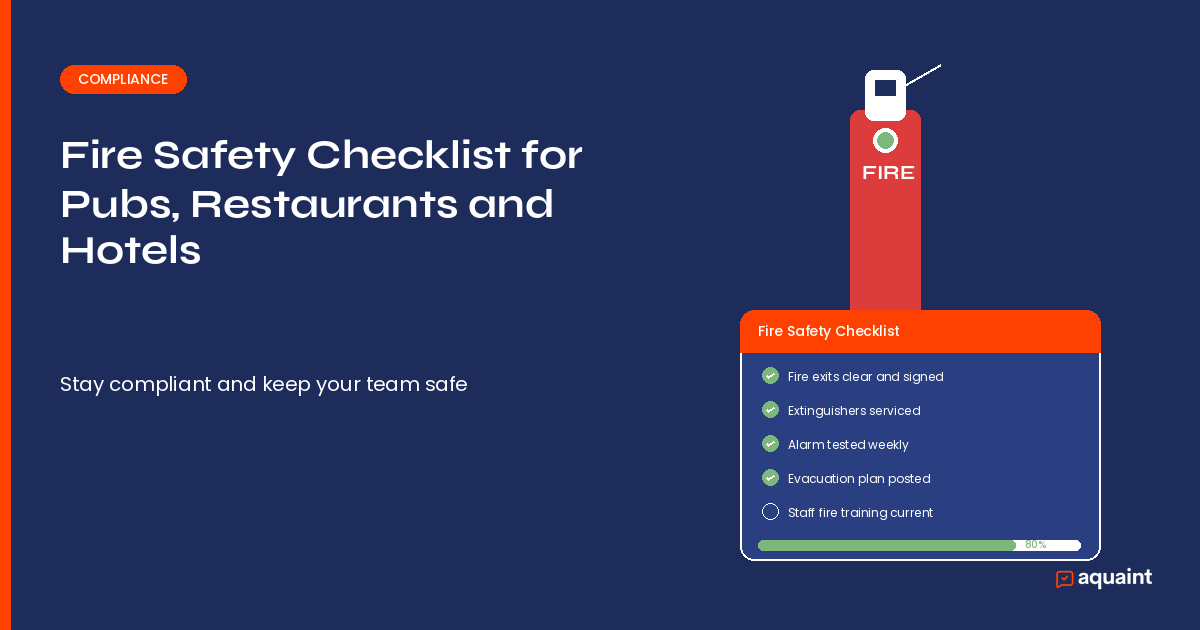
Fire Safety Checklist for Pubs, Restaurants and Hotels
Last updated: May 2026
In 2024, UK fire services attended over 27,000 fires in non-domestic buildings. Hospitality venues, with their mix of open kitchens, deep fat fryers, high footfall, and late-night trading, carry higher fire risk than most.
Yet fire safety compliance is one of the most overlooked areas in hospitality. Food safety gets the attention. Fire safety gets the afterthought.
That needs to change. Here's everything you need to know about fire safety compliance for pubs, restaurants, and hotels in the UK, plus a practical checklist you can start using today.

The Law: Regulatory Reform (Fire Safety) Order 2005
The Regulatory Reform (Fire Safety) Order 2005 (commonly called the Fire Safety Order or FSO) is the primary fire safety legislation for non-domestic premises in England and Wales. Scotland and Northern Ireland have equivalent legislation.
Under the FSO, every business that operates from a premises must:
- Carry out a fire risk assessment
- Appoint a responsible person
- Implement appropriate fire safety measures
- Maintain fire safety equipment
- Provide fire safety training to all staff
- Keep records of all fire safety activities
Failure to comply can result in fines, enforcement notices, prohibition notices (shutting your venue), or criminal prosecution. Since the Fire Safety Act 2021 (introduced following the Grenfell Tower inquiry), enforcement has tightened further.
Who Is the "Responsible Person"?
The responsible person is the individual accountable for fire safety in the premises. In hospitality, this is typically:
- The employer (if staff work at the premises)
- The occupier or person in control of the premises
- The owner (if the premises are unoccupied)
For a pub or restaurant, the responsible person is usually the business owner, operator, or a designated senior manager. In hotels, it's often the general manager.
The responsible person's duties include:
- Ensuring a suitable and sufficient fire risk assessment is in place
- Implementing fire safety measures identified in the assessment
- Appointing competent people to help with fire safety
- Providing information, instruction, and training to staff
- Cooperating with other responsible persons (e.g., in shared buildings)
- Reviewing the fire risk assessment regularly and after any significant changes
You can delegate tasks, but you can't delegate responsibility. If fire safety checks aren't happening, the responsible person is accountable.
Fire Risk Assessment: The Foundation
A fire risk assessment must identify:
- Fire hazards: sources of ignition, fuel, and oxygen
- People at risk: staff, customers, contractors, vulnerable people
- Existing fire safety measures: detection, warning, escape routes, firefighting equipment
- Actions needed: improvements, maintenance, training
For hospitality venues, common fire hazards include:
- Commercial kitchen equipment (fryers, grills, ovens)
- Extraction and ventilation systems (grease build-up)
- Electrical equipment and wiring
- Candles and tea lights (yes, those ones on every table)
- External bin stores near the building
- Outdoor heaters and fire pits
- Storage of cleaning chemicals and aerosols
The fire risk assessment should be reviewed at least annually and updated whenever there are significant changes to the premises, layout, or operations.
If you're also preparing for the new Martyn's Law requirements, your fire safety measures and evacuation plans will need to align with your wider security and public protection duties.
The Fire Safety Checklist
Here's a practical checklist broken down by frequency. Use this as a starting point and adapt it to your venue's specific fire risk assessment.
Daily Checks
- All fire exits and escape routes are clear and unobstructed
- Fire doors are closing properly and not wedged open (unless held by automatic release mechanisms linked to the fire alarm)
- Emergency lighting is visually checked and appears functional
- Fire extinguishers are in their designated positions and accessible
- Kitchen extraction system is clean and operational
- No accumulation of waste or combustible materials in escape routes, kitchens, or near exits
- External bin areas are tidy and bins are not positioned against the building
- Electrical equipment is switched off when not in use (where applicable)
- Candles or open flames (if used) are placed in secure holders on stable surfaces, away from combustible materials
Weekly Checks
- Fire alarm system tested (activate a different call point each week to test all over time)
- Emergency lighting functional test (brief activation)
- Fire doors inspected for damage, gaps, or faulty self-closing mechanisms
- Fire extinguishers checked for damage, tampering, or discharge
- Fire action notices are displayed and legible
- Escape route signage is visible and illuminated where required
- Kitchen suppression system visual check (if installed)
Monthly Checks
- Emergency lighting full duration test (3-hour test annually, monthly functional tests)
- Fire alarm system log reviewed for faults or false alarms
- Fire extinguisher condition check (pressure gauge, pin, seal)
- Sprinkler system visual inspection (if installed)
- Kitchen extraction deep clean schedule reviewed (professional deep clean typically every 6-12 months depending on usage)
- Fire risk assessment reviewed for any changes to premises or operations
- Staff fire safety training records reviewed (new starters trained?)
- Fire evacuation plan reviewed and updated if needed
Annual / Periodic Checks
- Full fire risk assessment review
- Fire alarm system serviced by a competent person (BS 5839 compliant)
- Emergency lighting full rated duration test and service
- Fire extinguishers serviced and certified by a competent person
- Kitchen extraction system professionally deep cleaned and certified
- Fire suppression system serviced (if installed)
- Sprinkler system serviced (if installed)
- Fire evacuation drill conducted (at least annually, more for hotels)
- Portable appliance testing (PAT) completed
- Fixed electrical installation condition report (EICR) reviewed (every 5 years or as recommended)
Recording Fire Safety Checks
The Fire Safety Order requires you to record your fire risk assessment findings (if you employ five or more people) and maintain records of fire safety activities. In practice, keeping records regardless of staff numbers is the safer approach.
Records you should keep include:
- Fire risk assessment and review dates
- Weekly fire alarm test results (date, call point tested, result)
- Emergency lighting test results
- Fire extinguisher checks and service dates
- Fire door inspection results
- Staff fire safety training dates and attendees
- Fire drill records (date, evacuation time, issues identified)
- Any fire safety incidents or near misses
- Maintenance and service certificates
Sound familiar? It's the same principle as food safety compliance. If it's not recorded, you can't prove it happened.
Aquaint's checklist features let you build fire safety checks into your team's daily, weekly, and monthly routines alongside food safety and other compliance tasks. Every check is timestamped and attributed to the team member who completed it, giving you a complete audit trail.
You can also store fire safety certificates, risk assessments, and service reports in Aquaint's document management system, keeping everything in one place rather than scattered across filing cabinets and email inboxes.
Common Fire Safety Mistakes in Hospitality
Wedging Fire Doors Open
This is the single most common fire safety violation in hospitality. Fire doors are designed to contain fire and smoke. Wedging them open defeats the purpose entirely. If you need doors held open for ventilation or access, install automatic door holders linked to the fire alarm system. They release when the alarm activates.
Blocked Escape Routes
Deliveries stacked in corridors. Cleaning equipment stored in front of fire exits. Beer kegs blocking the back door. It happens in every venue at some point. Build escape route checks into your daily opening routine to catch problems before they become hazards.
Neglecting Kitchen Extraction Cleaning
Grease build-up in extraction systems is one of the leading causes of commercial kitchen fires. Professional deep cleaning should happen every 6 to 12 months depending on your cooking volume. Keep the certificates. Inspectors ask for them.
Incomplete Training Records
Every staff member should receive fire safety training during induction. This includes the location of fire exits, how to raise the alarm, the evacuation procedure, and where the assembly point is. Record the training. Include the date, attendee names, and what was covered.
Ignoring False Alarms
Frequent false alarms lead to complacency. Staff start ignoring the alarm or silencing it without investigating. Every alarm activation should be investigated and recorded. If false alarms are a regular issue, get the system reviewed.
Fire Safety and Multi-Site Operations
If you operate multiple venues, fire safety compliance can get complicated. Different building layouts, different equipment, different local authority requirements.
The key is having a standardised checklist framework that can be adapted for each site. Your core daily, weekly, and monthly checks stay the same, but site-specific items (like the location of fire panels, suppression systems, or unique hazards) are added per venue.
With Aquaint, you can create site-specific checklists while maintaining consistency across your portfolio. Managers get visibility across all locations from a single dashboard, making it easier to spot sites that are falling behind on fire safety compliance.
What Happens During a Fire Safety Inspection?
Fire and Rescue Authority inspectors can visit your premises without notice. During an inspection, they'll typically:
- Ask to see your fire risk assessment
- Check escape routes and fire doors
- Inspect fire detection and alarm systems
- Review maintenance and testing records
- Check staff training records
- Look at your fire evacuation plan and drill records
- Inspect fire extinguishers and other firefighting equipment
The outcomes range from informal advice to formal enforcement. Enforcement notices require you to make improvements within a set timeframe. Prohibition notices can close your premises until hazards are addressed. Prosecution can follow for serious or repeated non-compliance.
Bringing It All Together
Fire safety compliance isn't a one-off task. It's an ongoing process that needs to be built into your venue's daily operations. The checklist above gives you a structured approach to staying on top of it.
Whether you're running a single pub or managing a portfolio of hotels, the fundamentals are the same: assess the risks, implement the measures, train your team, do the checks, and record everything.
If you're still managing fire safety on paper or spreadsheets, consider whether a digital compliance tool could make the process more reliable. When every check is logged with a timestamp and a name, you're in a far stronger position if an inspector walks through the door.
FAQs
Do I need a fire risk assessment for my pub or restaurant?
Yes. Under the Regulatory Reform (Fire Safety) Order 2005, every non-domestic premises in England and Wales must have a fire risk assessment. This applies to all hospitality venues including pubs, restaurants, cafes, hotels, and event spaces. The responsible person must ensure the assessment is carried out and reviewed regularly.
How often should I test my fire alarm?
Fire alarms should be tested weekly by activating a manual call point. Rotate which call point you test each week so all points are tested over time. A full system service by a competent person should happen at least annually in line with BS 5839.
Can I do my own fire risk assessment?
Yes, the responsible person can carry out their own fire risk assessment if they're competent to do so. However, for complex premises like large hotels or multi-storey venues, it's advisable to use a qualified fire risk assessor. The government publishes free fire safety guides for different premises types to help.
What records do I need to keep for fire safety?
You should keep records of your fire risk assessment, weekly alarm tests, emergency lighting tests, fire extinguisher checks and servicing, fire door inspections, staff training, fire drills, and any maintenance or service certificates. These records demonstrate compliance during inspections.
How does fire safety relate to Martyn's Law?
Martyn's Law (the Terrorism (Protection of Premises) Act) introduces security duties for public venues. While it focuses on terrorism preparedness, there's significant overlap with fire safety in areas like evacuation procedures, staff training, and emergency planning. Read our full guide to Martyn's Law for hospitality for more details.


Download your free template


Let's get aquainted - sign up to our newsletter
Join our newsletter to stay up to date on features and releases.