
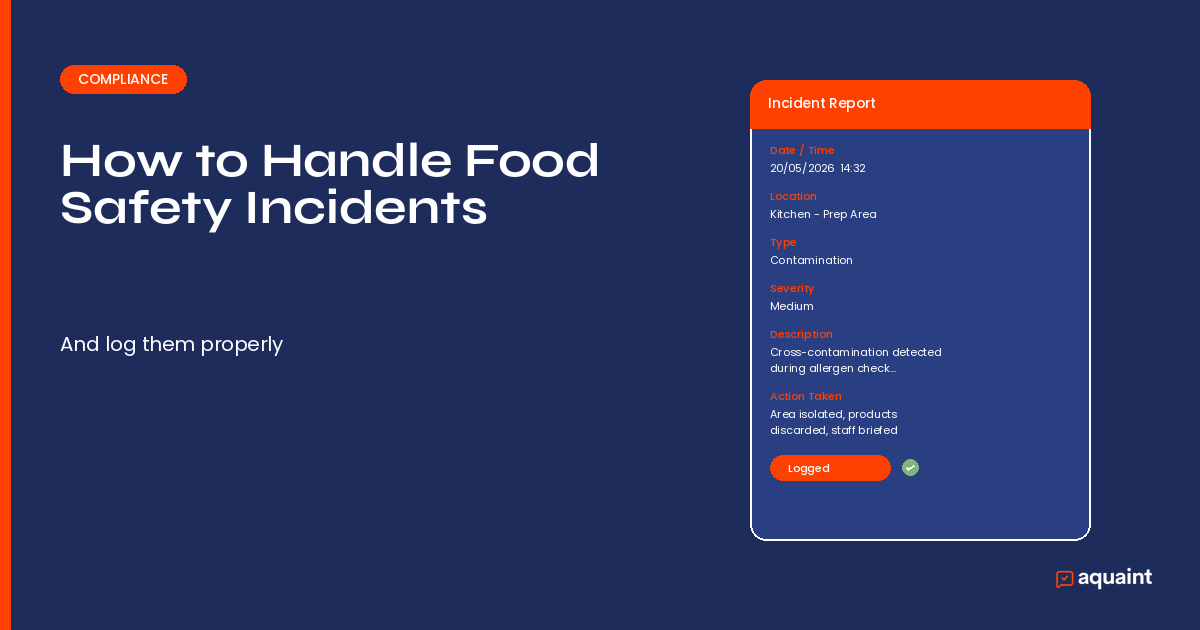
How to Handle Food Safety Incidents (and Log Them Properly)
Last updated: May 2026
A customer says they're having an allergic reaction. A team member finds glass in a food delivery. The walk-in fridge failed overnight and everything inside is above 8°C.
What do you do? More importantly, what do you record?
Food safety incidents happen in every hospitality business. The difference between a controlled situation and a crisis often comes down to how well your team responds in the first few minutes, and whether the right information gets logged.
This guide covers the main types of food safety incidents, what to record for each one, your legal reporting obligations, and how to build incident logging into your daily operations.

Types of Food Safety Incidents
Food safety incidents in hospitality generally fall into five categories:
1. Allergen Reactions
An allergen reaction is one of the most serious incidents a food business can face. In the UK, there are 14 allergens that must be declared by law, and the consequences of getting it wrong can be fatal.
Common scenarios include:
- A customer reports symptoms after eating (swelling, breathing difficulty, skin reaction)
- A dish is served containing an undeclared allergen
- Cross-contamination occurs during preparation
- Allergen information provided to the customer was incorrect
Immediate response:
- Take the customer's symptoms seriously. Do not dismiss or downplay them.
- Call 999 if the reaction is severe (anaphylaxis). Assist with the customer's adrenaline auto-injector if they have one and need help.
- Preserve the food involved. Do not dispose of it.
- Identify what the customer ate and check allergen records for those dishes.
- Notify the manager on duty immediately.
2. Contamination (Biological, Chemical, Physical)
Biological contamination includes bacteria, viruses, or parasites. This could be a suspected foodborne illness outbreak linked to your venue, or discovering mould, pest evidence, or spoiled ingredients.
Chemical contamination includes cleaning products, pesticides, or other non-food substances coming into contact with food. Common causes: unlabelled spray bottles, chemicals stored near food, residue from cleaning.
Physical contamination includes foreign objects found in food. Glass, metal, plastic, hair, plasters, packaging fragments, or pest droppings.
Immediate response:
- Remove the affected food from service
- Preserve the evidence (the food item, the foreign object, packaging)
- Identify the source if possible
- Check whether other portions from the same batch were served
- Notify the manager on duty
3. Temperature Breaches
Temperature control failures are one of the most common food safety incidents. They include:
- Fridge or freezer failure (equipment breakdown or power cut)
- Food left in the temperature danger zone (8°C to 63°C) for too long
- Hot held food dropping below 63°C
- Food not reaching adequate cooking or reheating temperatures
- Delivery arriving at incorrect temperatures
Immediate response:
- Check and record the current temperature
- Determine how long the temperature breach has lasted (if possible)
- Assess which food items are affected
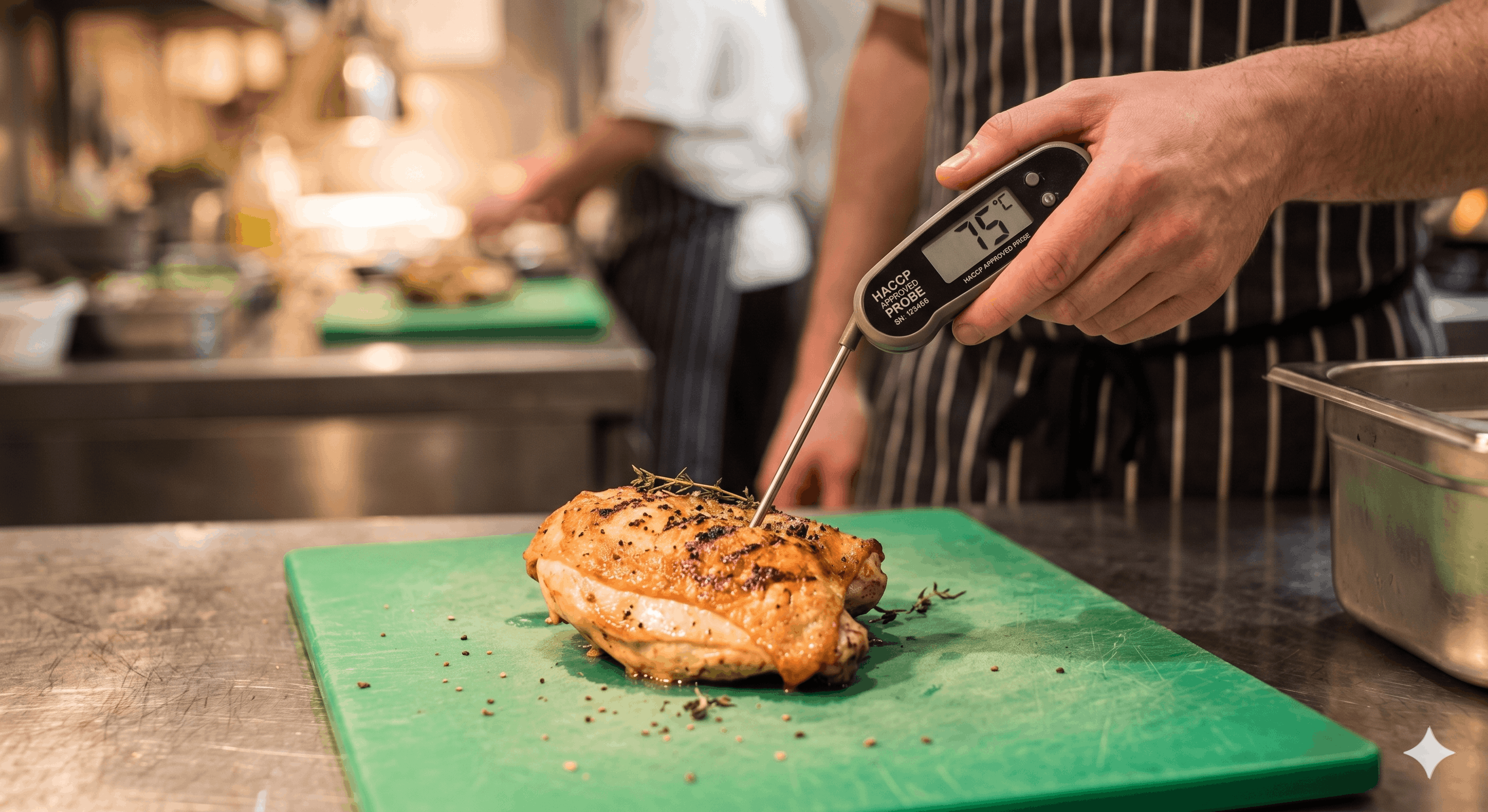
- Decide whether food can be salvaged or must be disposed of (follow your HACCP corrective actions)
- Record everything, including what was disposed of and why
4. Customer Complaints (Food Safety Related)
Not every complaint is a food safety incident. But complaints about illness after eating, foreign objects, undercooked food, or off-tasting food need to be treated as potential food safety issues.
Immediate response:
- Listen to the customer and take the complaint seriously
- Record the details: what they ate, when, symptoms (if any)
- Preserve any remaining food from the same batch
- Follow up with the customer
- Investigate internally
5. Staff Illness
Staff who are vomiting, have diarrhoea, or have been diagnosed with a foodborne illness must not handle food. This is a legal requirement under food hygiene regulations.
Immediate response:
- Send the staff member home
- Record the illness and the date they were excluded from food handling
- They should not return to food handling duties until at least 48 hours after symptoms have stopped
- Clean and disinfect any areas they may have contaminated
What to Record for Every Incident
Regardless of the type, every food safety incident should be logged with these details:
- Date and time of the incident
- Date and time the incident was discovered or reported
- Who reported it (staff member name, or customer details if applicable)
- Description of what happened
- Food items involved (dish names, batch numbers, supplier details if relevant)
- People affected (customers, staff)
- Immediate actions taken (food removed, area cleaned, ambulance called, etc.)
- Evidence preserved (food samples, foreign objects, photos)
- Follow-up actions (investigation, process changes, retraining)
- Who managed the incident (manager on duty)
- Outcome (resolved, reported to authorities, ongoing)
The more detail you capture at the time, the better your position if the incident escalates to an investigation, insurance claim, or legal action.
Legal Reporting Requirements
Reporting to Your Local Authority
If you suspect food you've served has caused illness to two or more people (a potential outbreak), you must report it to your local authority environmental health team. They'll work with you to investigate and may involve Public Health England (or equivalent bodies in Scotland, Wales, and Northern Ireland).
RIDDOR Reporting
Some food safety incidents cross into RIDDOR (Reporting of Injuries, Diseases and Dangerous Occurrences Regulations) territory. You must report to the HSE if:
- A member of staff contracts a work-related disease linked to biological agents (e.g., certain foodborne illnesses contracted through work)
- An incident results in a member of the public being taken to hospital
- There's a dangerous occurrence that could have led to serious injury
RIDDOR reports must be made without delay, and in the case of fatal or specified injuries, within specific timeframes. Check our full RIDDOR guide for the details.
Food Standards Agency Notifications
If you identify a food safety hazard that could affect other businesses (e.g., a contaminated ingredient from a supplier), you should notify the Food Standards Agency. This triggers the food incident response process and may result in a product recall or withdrawal.
Time Limits You Need to Know
- RIDDOR fatal/specified injuries: report immediately and follow up within 10 days
- RIDDOR over-7-day incapacitation: report within 15 days
- Suspected outbreaks: report to local authority as soon as possible
- Food hazard notifications: report to FSA without delay
Beyond legal requirements, your own internal incident records should be completed on the same day as the incident. The longer you wait, the less accurate the details become.
Building Incident Logging Into Your Operations
Incident logging shouldn't be a scramble for a blank piece of paper and a pen. Here's how to make it part of your operational routine:
Create a Standardised Incident Form
Whether digital or paper (though digital is better for all the reasons covered in our paper vs digital compliance guide), have a consistent format that captures all the details listed above. A structured form makes sure nothing gets missed in the heat of the moment.
Train Every Team Member
Every staff member should know:
- What counts as a food safety incident
- What to do immediately (the first response)
- How to log it
- Who to escalate to
This isn't a once-a-year training session. Build it into induction and reinforce it regularly.
Make Logging Quick and Accessible
If logging an incident takes 20 minutes and three different forms, it won't happen consistently. The easier the process, the more reliable your records.
Aquaint's incident logging feature lets team members record incidents directly from their phone. The entry is timestamped automatically, tagged to the right site, and visible to managers in real time. No hunting for forms. No waiting until the end of shift to write it up from memory.
Review Incidents Regularly
Don't let incident logs sit unread. Review them weekly or monthly as part of your management routine. Look for patterns:
- Are temperature breaches happening at the same time of day?
- Is one site generating more incidents than others?
- Are the same types of incidents recurring?
Patterns point to system problems, not one-off mistakes. Fix the system and the incidents reduce.
After the Incident: Corrective Actions
Logging the incident is step one. What you do next is what prevents it from happening again.
For every incident, record your corrective actions:
- What process or procedure change was made?
- Was retraining provided? To whom?
- Was equipment repaired or replaced?
- Was a supplier contacted or changed?
- Was the HACCP plan updated?
Your corrective action record is part of your due diligence defence. It shows that you don't treat incidents as isolated events. You learn from them.
Incident Logging for Multi-Site Operations
If you're running multiple venues, incident visibility becomes more important and more difficult. A serious incident at one site might indicate a supplier issue affecting all your locations.
Centralised incident logging gives you that visibility. With Aquaint, incidents logged at any site are visible to area managers and head office in real time, so you can respond across the business rather than discovering the same problem at three different sites over three different weeks.
The Cost of Not Logging
When a food safety incident isn't logged, several things happen. None of them are good.
- If the incident leads to a complaint, investigation, or legal claim, you have no record of what happened or what you did about it
- Patterns go unnoticed, so the same problems keep recurring
- Your EHO inspection score suffers because you can't demonstrate incident management procedures
- Your due diligence defence weakens significantly
- Insurance claims become harder to defend
A two-minute incident log at the time is worth infinitely more than trying to reconstruct what happened six weeks later.
FAQs
What counts as a food safety incident?
Any event that could affect the safety of food served to customers. This includes allergen reactions, contamination (biological, chemical, or physical), temperature control failures, customer illness complaints, staff illness, and any breach of your food safety management system.
Do I have to report food safety incidents to the local authority?
You must report suspected outbreaks (two or more linked cases of illness) to your local authority environmental health team. Individual incidents should be logged internally. Some incidents also require RIDDOR reporting to the HSE. When in doubt, report it.
How long should I keep food safety incident records?
There's no specific legal retention period for food safety incident records, but best practice is to keep them for at least three years. For incidents involving serious illness or legal claims, keep records for at least six years (the general limitation period for civil claims in England and Wales).
What should I do if a customer reports an allergic reaction?
Take it seriously. Call 999 if the reaction is severe. Preserve the food involved. Record what the customer ate, when, and the allergen information provided. Investigate how the allergen exposure occurred. Log everything including your findings and corrective actions.
Can digital incident logging help during an EHO inspection?
Yes. Timestamped digital incident records show inspectors that you have a functioning incident management system. Being able to pull up a complete log of incidents, responses, and corrective actions demonstrates that your business takes food safety seriously and acts on problems when they arise.





Let's get aquainted - sign up to our newsletter
Join our newsletter to stay up to date on features and releases.