
Hot Holding Temperature UK: The 2-Hour Rule
Last updated: June 2026
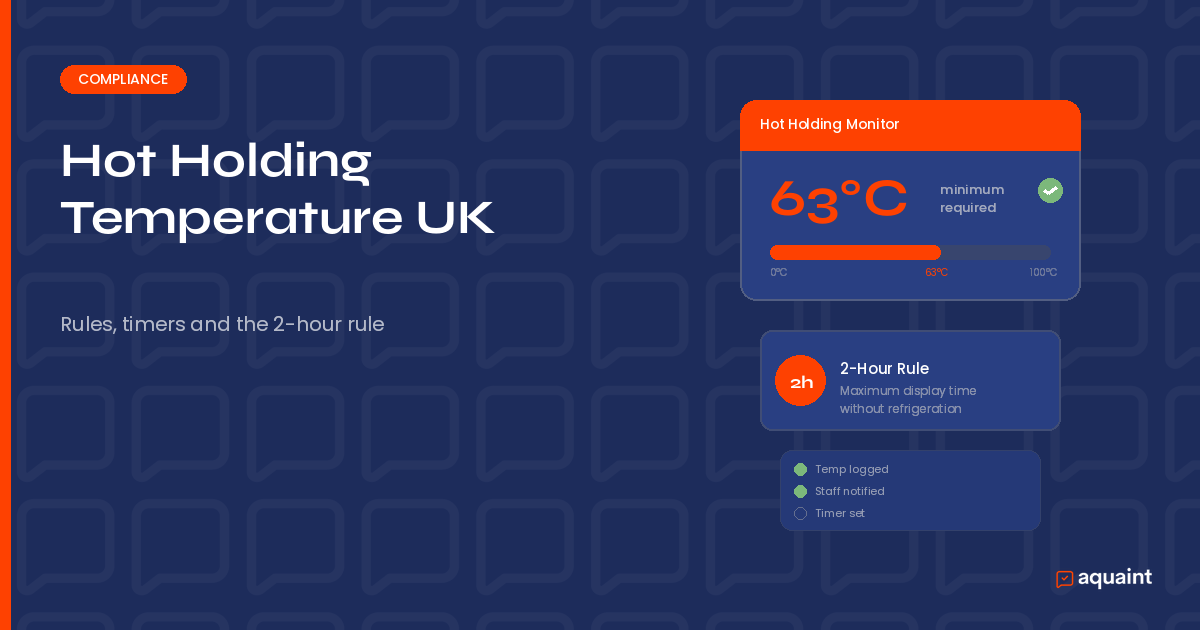
Hot holding temperature in the UK, in one line: keep hot food at 63°C or above. If it drops below, you can use time as a control for up to 2 hours, once, then serve it, cool it to below 8°C, or discard it. The danger zone is 8°C to 63°C.
The risk is real. The Food Standards Agency estimates 2.4 million cases of foodborne illness in the UK each year, costing society around £10.4 billion. Hot holding is one of the easiest controls to get wrong, and one of the first things an EHO probes.
This guide breaks down the UK hot holding requirements for hospitality venues: the legal temperature, the time-based exemption, how to monitor it properly, and what EHOs look for during an inspection.
What Temperature Should Hot Food Be Held At in the UK?
63C or above. That's the legal minimum for hot holding in England, Wales, and Northern Ireland under the Food Safety and Hygiene (England) Regulations 2013.
In Scotland, the requirement is 63C as well, set by the Food Hygiene (Scotland) Regulations 2006.
This applies to any food that's being kept hot for service - whether that's a carvery counter, a buffet, a bain-marie, soup kettles, pie warmers, or hot display cabinets.
Important: 63C is a minimum, not a target. Running your hot holding equipment at exactly 63C means any fluctuation drops you below the legal line. Most venues aim for 65-70C to give themselves a comfortable margin.
The 2-Hour Rule: What Happens When Food Drops Below 63C
This is the bit most kitchens get wrong. Or don't know about at all.
Under UK food safety law, if hot food drops below 63C, you can use time as a control instead of temperature. But there are strict conditions:
- The food can be kept below 63C for a maximum of 2 hours
- This is a one-time exemption - you can only do it once per batch of food
- After 2 hours, you must either serve it, cool it rapidly to below 8C, or discard it
- You cannot reheat food that's been through the 2-hour rule and put it back on hot hold
- You must document when the food dropped below temperature and when the 2-hour window started
The common mistakes:
- Not timing it. If you don't record when the food dropped below 63C, you can't prove you stayed within the 2-hour window
- Reheating and re-holding. Once food has used its 2-hour exemption, it's done. Reheating it and putting it back on the hot counter is not allowed
- Using the 2-hour rule as standard practice. It's meant as a safety net, not a daily operating procedure. If your hot holding equipment can't maintain 63C, fix the equipment
How to Monitor Hot Holding Temperatures
Checking hot holding temperatures isn't a once-a-day job. Food on a hot counter can lose temperature gradually, and by the time it's visibly cooled down, it's been in the danger zone for longer than you think.
Best practice monitoring:
- Check hot-held food every 2 hours at minimum
- Use a calibrated probe thermometer to check the core temperature of the food, not the surface
- Record every check: time, temperature, food item, who checked
- If below 63C: start the 2-hour countdown and record the time
Where to probe:
- Centre of the food, not the edges (edges cool first and give a misleadingly low reading)
- If it's a deep container, probe at different depths
- For large items (whole joints, large pies), probe the thickest part
Equipment checks:
- Verify your bain-marie or hot cabinet is reaching and holding 63C+ before you load food into it
- Check that water levels in bain-maries are correct (low water means uneven heating)
- Position probes away from the heating elements for a true reading
The Danger Zone: Why 63C Matters
The temperature danger zone for food is 8C to 63C. Within this range, bacteria can multiply rapidly, with some species doubling every 20 minutes under ideal conditions.
Hot holding at 63C keeps food right above this danger zone. It doesn't kill bacteria (that requires higher temperatures), but it prevents them from multiplying to dangerous levels.
This is why food can't sit at room temperature waiting to be served. Between 20-40C, bacteria grow fastest. A pot of soup left on a switched-off hob can go from safe to unsafe within a couple of hours.
Key danger zone facts:
- 0-8C: bacterial growth is minimal (fridge zone)
- 8-63C: the danger zone where bacteria multiply rapidly
- 63C+: bacteria can't multiply (hot holding zone)
- 75C: the target for killing most harmful bacteria (cooking/reheating zone)
Hot Holding for Different Service Types
Buffets and Carveries
The biggest hot holding challenge. Food is exposed, customers serve themselves, and equipment runs for hours.
- Use heated display units that maintain 63C+ throughout
- Check temperatures every 2 hours and record
- Replace food in full containers rather than topping up (topping up mixes old and new food)
- Cover food where possible to retain heat and prevent contamination
- At the end of service: discard anything that's been out, don't re-chill for tomorrow
Bain-Maries
The workhouse of most hot kitchens. Reliable, but they need attention.
- Ensure water level is correct (low water = cold spots)
- Pre-heat the bain-marie before loading food (putting food into cold water defeats the purpose)
- Don't overload containers (food in the centre of a deep, full container loses heat)
- Check that all positions are holding 63C+, not only the ones nearest the element
Pie Warmers and Hot Cabinets
Common in pubs, cafes, and grab-and-go venues.
- Verify the cabinet reaches 63C (some older models don't)
- Don't load cold food directly into a hot cabinet. Cook or reheat to 75C first, then transfer
- Rotate stock: first in, first out
- Clean regularly. Grease build-up reduces heating efficiency
Soup Kettles
- Stir regularly to distribute heat evenly
- Probe the centre of the pot, not the surface (the surface is hotter)
- Keep lids on when not serving to retain temperature
- Don't add cold stock to a hot kettle to "top up" during service
What EHOs Check for Hot Holding
During an inspection, your EHO will:
- Probe your hot food - they carry their own probe and will check random items on your hot counter
- Ask about the 2-hour rule - they want to know if your team understands the time-based exemption and how it works
- Check your records - consistent hot holding logs with timestamps show good management
- Look at your equipment - is it clean, working, and capable of maintaining 63C?
- Ask a team member - they might ask a random staff member what they'd do if a hot item dropped below temperature
The question that catches people out: "What do you do if this soup drops below 63C?"
The right answer: "We'd record the time it dropped, start the 2-hour clock, and either serve it, cool it to below 8C, or discard it within 2 hours. We wouldn't reheat it and put it back."
If your team can answer that confidently, you're scoring well on confidence in management.
How Aquaint Handles Hot Holding
Tracking hot holding manually means remembering to check, finding the log sheet, writing it down, and hoping everyone on shift does the same. Aquaint turns it into a guided workflow:
- Scheduled hot holding checks at intervals you set
- 2-hour rule timers that start automatically when a reading drops below 63C
- Corrective action prompts so your team knows exactly what to do next
- Digital records searchable by date, site, and team member
- EHO-ready reports in one tap
No clipboard. No forgotten checks. No guessing whether the soup's been sitting there for one hour or three.
Book a free demo and see how it works for your venue.
FAQs
What is the hot holding temperature in the UK? 63C or above. This is the legal minimum for food being kept hot for service. Most venues aim for 65-70C to allow for minor fluctuations. This applies to all food businesses in England, Wales, Scotland, and Northern Ireland.
What is the 2-hour rule for hot food? If hot food drops below 63C, you can keep it at that lower temperature for a maximum of 2 hours. After 2 hours, you must serve it, cool it rapidly to below 8C, or discard it. You can only use this exemption once per batch.
Can I reheat food that's dropped below 63C and put it back on hot hold? No. Once food has used its 2-hour time exemption, you cannot reheat it and return it to hot holding. It must be served, cooled, or discarded.
How often should I check hot holding temperatures? Every 2 hours at minimum. Use a calibrated probe to check the core temperature of the food, not the surface. Record every check with the time, temperature, and food item.
What's the difference between hot holding and reheating? Reheating means bringing food up to a safe temperature (75C for 30 seconds) from cold. Hot holding means maintaining food that's already been cooked or reheated at 63C or above for service. You must reheat food properly before transferring it to hot holding equipment.
Can I put cold food straight into a hot holding unit? No. Always cook or reheat food to 75C (core temperature) first, then transfer to your hot holding equipment. Hot cabinets and bain-maries are designed to hold temperature, not to cook or reheat.
What happens if my bain-marie can't maintain 63C? Get it serviced or replaced. Using the 2-hour rule as a workaround for faulty equipment is not acceptable. If an EHO sees your hot holding consistently below temperature, they'll flag it as a management failure.
Do I need to log hot holding temperatures? Yes. While there's no specific format required by law, keeping a documented record of hot holding checks demonstrates good food safety management and scores well during EHO inspections.
Related Reading
- UK Food Safety Temperatures: The FSA Chart + Checklist
- Fridge and Freezer Temperatures for UK Restaurants: The Complete Guide
- Hot Holding Temperature UK: Rules, Timers and the 2-Hour Rule
- Cooking and Reheating Temperatures UK: The FSA Guide for Hospitality
- EHO Inspection Checklist 2026: Get 5 Stars
- HACCP Plan Template for UK Hospitality (Free PDF)



Let's get aquainted - sign up to our newsletter
Join our newsletter to stay up to date on features and releases.