
Cooking & Reheating Temperatures UK (2026)
Last updated: June 2026
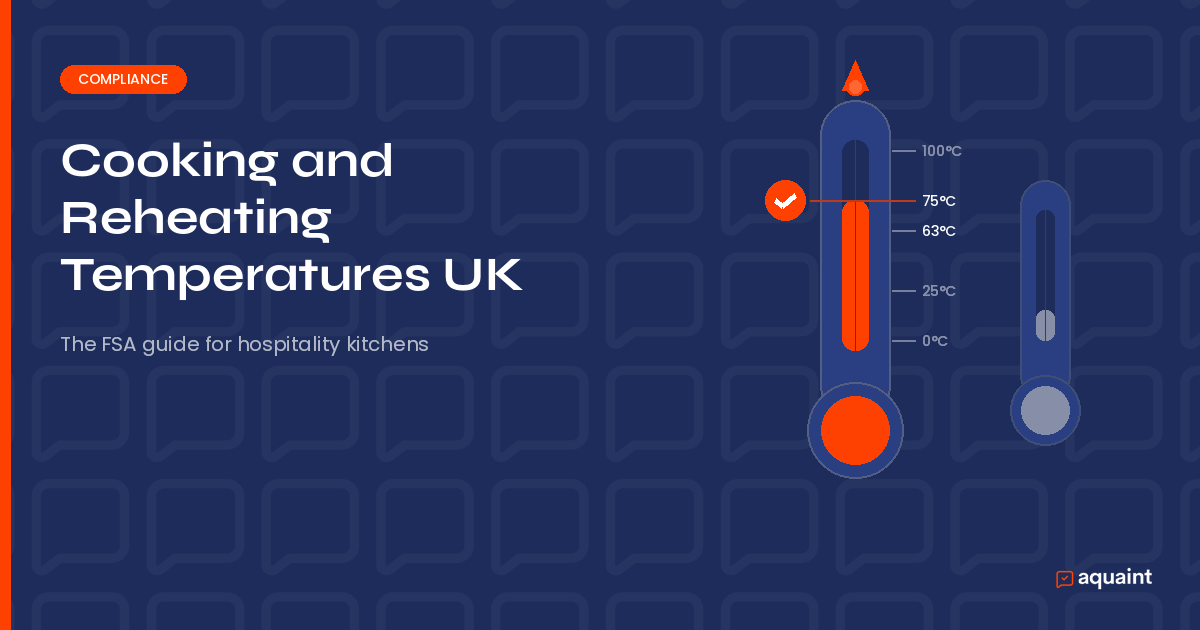
UK cooking and reheating temperatures, in one line: cook or reheat food to a core 75°C for 30 seconds, or an approved equivalent such as 70°C for 2 minutes. Reheat once only, and never use hot holding equipment to do it. The danger zone is 8°C to 63°C, so food should pass through it quickly.
The risk is real. The Food Standards Agency estimates 2.4 million cases of foodborne illness in the UK each year, costing society around £10.4 billion, much of it down to undercooking or poor reheating. Most kitchens cook safely; the gap is usually in the recording, and that is where EHO points get lost.
This guide covers the UK cooking and reheating temperature requirements for hospitality venues: what the FSA expects, the approved time/temperature combinations, how to log it, and the mistakes that cost venues their 5-star rating.
UK Cooking Temperatures: What the FSA Requires
The standard safe cooking temperature in the UK is 75C for 30 seconds at the core of the food. This is the target that kills most harmful bacteria, including Salmonella, E. coli, Listeria, and Campylobacter.
"At the core" matters. Surface temperature means nothing here. You need to probe the thickest part of the food - the centre of a chicken breast, the middle of a burger, the deepest part of a lasagne. If the core hits 75C and stays there for 30 seconds, the food is safe.
Time/Temperature Equivalents
The FSA recognises that 75C for 30 seconds isn't the only safe combination. These alternatives achieve the same level of bacterial kill:
| Temperature | Time Required |
|---|---|
| 60C | 45 minutes |
| 65C | 10 minutes |
| 70C | 2 minutes |
| 75C | 30 seconds |
| 80C | 6 seconds |
When would you use these? Slow-cooked dishes, sous vide cooking, and large joints of meat often reach their target temperature more gradually. A beef brisket cooked low and slow might hold at 65C for hours, which is far more than the 10 minutes required. That's perfectly safe.
The key is knowing which combination applies to what you're cooking and being able to explain it to an EHO if asked. "We cook it until it looks done" isn't an acceptable answer. "We probe to 70C and hold for 2 minutes" is.
Reheating Temperatures: The Rules
Reheating food in the UK follows the same target: 75C for 30 seconds at the core.
But reheating has additional rules that cooking doesn't:
- Reheat rapidly. Don't let food sit in the danger zone (8-63C) while it slowly warms up. The faster it passes through this range, the less time bacteria have to multiply
- Only reheat once. Food should be reheated once only. If it's been cooked, cooled, and reheated, it cannot be cooled and reheated again
- Don't use hot holding equipment to reheat. Bain-maries, hot cabinets, and soup kettles are designed to hold temperature, not raise it. They heat food too slowly, keeping it in the danger zone for too long
- Reheat within 24 hours of cooking where possible (this is best practice, not a hard legal limit, but EHOs look favourably on it)
The right way to reheat:
- Use an oven, microwave, hob, or salamander
- Heat rapidly to 75C at the core
- Probe to confirm
- Transfer to hot holding equipment (63C+) if not serving immediately
- Record the time, temperature, and food item
What Temperature Kills Bacteria in Food?
This is one of the most common questions, and the answer is more nuanced than a single number.
Most harmful bacteria are killed at 70-75C when held for the required time. But different bacteria have different thermal death points:
- Salmonella: killed at 60C after 15-20 minutes, or instantly at 75C
- E. coli O157: killed at 70C for 2 minutes
- Listeria monocytogenes: killed at 70C for 2 minutes (but can grow slowly at fridge temperatures, which is why proper chilling matters too)
- Campylobacter: one of the most heat-sensitive pathogens, killed at 60C within minutes
- Clostridium perfringens: the bacteria itself is killed by cooking, but its spores can survive. This is why cooling food rapidly after cooking is critical - the spores can germinate and produce toxins if food sits in the danger zone
The practical takeaway: 75C for 30 seconds covers all common food pathogens. It's the simplest, safest target for any kitchen.
Cooking Temperature Rules by Food Type
Poultry (Chicken, Turkey, Duck)
Core temperature: 75C for 30 seconds. No exceptions.
Poultry is the highest-risk protein in most kitchens because of Campylobacter and Salmonella. There's no such thing as "medium-rare chicken" in the UK.
- Probe the thickest part of the breast or the innermost part of the thigh
- Check that juices run clear (but don't rely on this alone - always probe)
- Record every batch with temperature and time
Beef, Lamb, and Pork
Whole cuts: Can be served pink/rare as long as the surface is seared. Bacteria on whole cuts sit on the outside, so searing the surface is enough to kill them.
Minced or processed meat (burgers, sausages, meatballs): Must reach 75C at the core. When meat is minced, bacteria from the surface get mixed throughout, so the entire product needs to reach a safe temperature.
This is why a rare steak is safe but a rare burger isn't (unless you're using a verified supplier with specific controls, which is a separate conversation).
Fish and Seafood
Core temperature: 63C minimum, though many chefs cook to 70-75C for safety margin.
Shellfish requires particular care: - Mussels and clams: cook until shells open fully - Prawns: cook until pink throughout - Raw fish for sushi/sashimi: requires specific supplier controls and food safety procedures beyond standard cooking temperatures
Eggs
Cook until both white and yolk are firm for maximum safety, especially in care settings or when serving vulnerable groups.
For dishes with runny yolks: use pasteurised eggs or eggs from a Lion Code-assured source (the red lion stamp), which have been vaccinated against Salmonella.
Rice
Rice is a common source of Bacillus cereus food poisoning, and it's almost always caused by poor cooling rather than poor cooking.
- Cook rice to boiling
- If not serving immediately, cool within 1 hour and refrigerate
- Do not keep cooked rice at room temperature for more than 1 hour
- Reheat to 75C and serve immediately
- Do not reheat rice more than once
How to Log Cooking and Reheating Temperatures
Your cooking and reheating records should include:
- Date and time
- Food item and batch identifier
- Core temperature achieved
- Time held at that temperature (if using alternatives to 75C/30s)
- Who took the reading
- Probe ID (if you use multiple probes)
When to record:
- First batch of each product at the start of service
- When you change product type, size, or cooking method
- Spot checks during service
- All reheated items (every time, no exceptions)
The recording trap: Many kitchens probe correctly but don't record it. When the EHO asks for cooking temperature records and you say "we always check but we don't write it down," that's the same as not checking at all in their eyes.
Common Mistakes That Cost EHO Points
1. Relying on timers instead of probes "We cook chicken for 25 minutes" isn't a temperature control. Different ovens, different sizes, different starting temperatures all change the outcome. The only reliable check is probing the core.
2. Probing the wrong spot The thinnest part of a chicken breast will hit 75C long before the thickest part. Always probe the thickest section, the centre of the food, or the area furthest from the heat source.
3. Not recording reheated items Cooking gets logged. Reheating often doesn't. But from a food safety perspective, reheating is higher risk than initial cooking because the food has already been through one cooling cycle. Record it every time.
4. Topping up hot food with cold Adding cold rice to a half-empty rice container on the hot counter is a common shortcut. It drops the temperature of the entire container into the danger zone and mixes new food with old. Replace containers entirely.
5. Defrosting in warm water or at room temperature This isn't a cooking temperature issue directly, but it's where many cooking problems start. Food that's partially frozen in the centre won't cook evenly. Always defrost in the fridge (below 8C) or under cold running water.
How Aquaint Helps With Cooking and Reheating Records
Paper cooking logs work in theory. In a busy kitchen during a Friday night service, they don't.
Aquaint builds cooking and reheating records into your team's workflow:
- Cook/reheat temperature capture with time/temperature equivalents built in
- Batch tracking so you know which product, when, and who checked it
- Corrective action prompts when temperatures don't hit the target
- Probe calibration logs linked to your temperature records
- EHO-ready reports that pull cooking, reheating, and hot holding data together in one view
Your EHO asks for your cooking records. You pull them up in 10 seconds on a tablet. That's the difference between a 4 and a 5.
Book a free demo and see how it works.
FAQs
What temperature should food be cooked to in the UK? 75C for 30 seconds at the core. This is the standard safe target recommended by the FSA. You can also use approved time/temperature equivalents: 70C for 2 minutes, 65C for 10 minutes, or 60C for 45 minutes.
What temperature should reheated food reach? 75C for 30 seconds at the core, the same as cooking. Reheat rapidly using an oven, microwave, or hob. Never use hot holding equipment like bain-maries to reheat food.
Can I reheat food more than once? No. Food should only be reheated once. If it's been cooked, cooled, and reheated, it cannot be cooled and reheated again. Discard any reheated food that isn't served.
What temperature kills bacteria in food? Most harmful bacteria are killed at 70-75C when held for the required time. The standard target of 75C for 30 seconds covers all common food pathogens including Salmonella, E. coli, and Listeria.
Is it safe to serve rare beef in a restaurant? Whole cuts of beef and lamb can be served rare as long as the surface has been properly seared. Minced or processed meats (burgers, meatballs) must reach 75C at the core because bacteria can be distributed throughout the product.
Do I need to record cooking temperatures? Yes. Record the first batch and whenever you change product type, size, or equipment. Spot-check during service. Your EHO will ask for cooking temperature records, and not having them affects your "confidence in management" score.
What's the danger zone for food temperature? 8C to 63C. Within this range, bacteria can multiply rapidly. Food should pass through this zone as quickly as possible during cooking, cooling, and reheating.
How do I know my probe thermometer is accurate? Calibrate weekly using the ice water method (should read 0C) and boiling water method (should read 100C). Record the results. If readings are off by more than 1C, recalibrate or replace the probe.
Related Reading
- UK Food Safety Temperatures: The FSA Chart + Checklist
- Fridge and Freezer Temperatures for UK Restaurants: The Complete Guide
- Hot Holding Temperature UK: Rules, Timers and the 2-Hour Rule
- Cooking and Reheating Temperatures UK: The FSA Guide for Hospitality
- EHO Inspection Checklist 2026: Get 5 Stars
- HACCP Plan Template for UK Hospitality (Free PDF)



Let's get aquainted - sign up to our newsletter
Join our newsletter to stay up to date on features and releases.