
RIDDOR Reporting: A Guide for Hospitality
Last updated: April 2026
RIDDOR - the Reporting of Injuries, Diseases and Dangerous Occurrences Regulations 2013 - requires employers to report certain workplace incidents to the HSE. For hospitality venues, this covers everything from a serious kitchen burn to a slip in the restaurant that puts someone in hospital. Getting it wrong isn't an admin issue - it's a legal obligation with real consequences.
Here's exactly what you need to know, without the legalese.
Which Incidents Must Be Reported Under RIDDOR?
Not every workplace accident needs a RIDDOR report. The HSE's reportable incidents page has the full list, but these are the ones that matter for hospitality:
Deaths. Any death of a worker or non-worker (customer, visitor, delivery driver) resulting from a work-related accident must be reported immediately.
Specified injuries to workers. These include fractures (other than fingers, thumbs, or toes), amputations, crush injuries, loss of sight, burns covering more than 10% of the body, and any injury from electric shock or scalding that requires resuscitation or hospital admission for over 24 hours.
Over-7-day incapacitation. If a worker is incapacitated for more than 7 consecutive days (not counting the day of the accident) as a result of a workplace injury, you must report it. The 7 days includes weekends and rest days, not only scheduled shifts.
Non-worker injuries requiring hospital treatment. If a customer, visitor, or other non-worker is taken directly to hospital for treatment as a result of an accident at your venue, that's reportable. This is the one hospitality venues most commonly miss - a customer who slips on a wet floor and goes to A&E triggers a RIDDOR report.
Occupational diseases. Certain work-related illnesses must be reported, including occupational dermatitis (common in kitchen workers from chemical exposure) and occupational asthma.
Dangerous occurrences. Near-miss events that could have resulted in a reportable injury - structural collapse, electrical failures, pressure vessel failures.
What Information Goes in the Report?
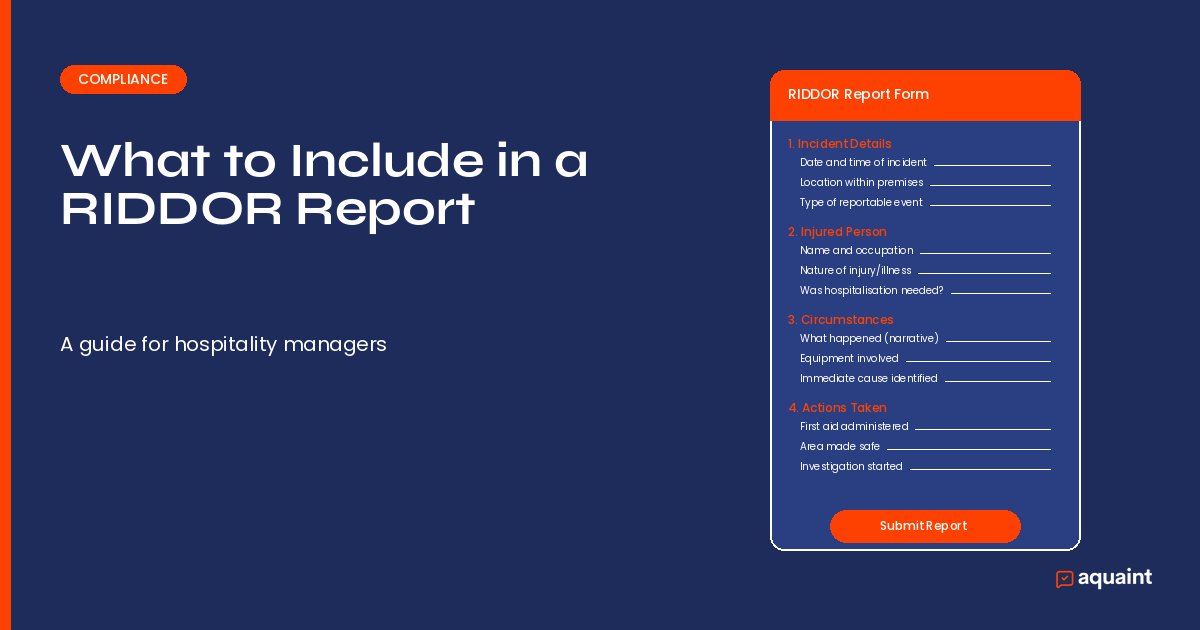
When you submit a RIDDOR report via the HSE's online form, you'll need:
About your venue:
- Business name and address
- Your name and contact details as the responsible person
- Type of business (hospitality, food service, etc.)
- Number of employees at the venue
About the injured person:
- Full name, address, date of birth
- Their role (employee, agency worker, customer, visitor)
- If an employee: their occupation, how long they've worked for you
About the incident:
- Date, time, and exact location of the incident
- A detailed description of what happened - not "slipped in kitchen" but the full sequence: what the person was doing, what went wrong, what the surface/equipment/conditions were
- The injury sustained and its severity
- What immediate action was taken (first aid, ambulance called, area cordoned off)
- Details of any witnesses
About the context:
- What equipment was involved, if any
- Were normal procedures being followed?
- Has a similar incident happened before?
- What preventive measures were already in place?
Deadlines You Can't Miss
Deaths and specified injuries: Report immediately by phone to the HSE (0345 300 9923), then follow up with an online report within 10 days.
Over-7-day incapacitation: Report within 15 days of the incident via the online form.
Non-worker hospital treatment: Report within 10 days via the online form.
Missing these deadlines is a criminal offence. The HSE can prosecute, and fines for non-compliance are uncapped for the most serious failings.
Common Mistakes Hospitality Venues Make
Not recognising reportable incidents. The biggest one. A customer trips on a loose carpet tile and goes to hospital? That's RIDDOR. A chef burns their hand badly enough to miss 8 days of work? That's RIDDOR. Many venues treat these as internal matters when they're legally required to report them.
Incomplete descriptions. "Staff member slipped in kitchen" tells the HSE nothing useful. They want context: was the floor wet? Was there a cleaning schedule in place? Was the person wearing appropriate footwear? Were there warning signs displayed? The more detail you provide, the less likely you are to face a follow-up investigation.
Not preserving the scene. After a reportable incident, you're required to preserve the scene (as far as reasonably practicable) until the HSE decides whether to investigate. Don't clean up, move equipment, or repair damage until you're sure no investigation is coming.
Poor record-keeping. Even incidents that don't meet RIDDOR thresholds should be recorded internally. Near misses, minor injuries, and customer complaints all form part of your safety picture. When an HSE inspector asks about your incident history, you want comprehensive records - not blank looks. This ties into your wider compliance reporting system.
How to Build a RIDDOR-Ready Incident Reporting System
The venues that handle RIDDOR well don't wait until an incident happens to figure out the process. They have a system that makes reporting the default, not an afterthought.
Train every team member to recognise what a reportable incident looks like. Front-of-house staff, kitchen teams, and managers should all know the basics. Build this into your new starter induction. If someone isn't sure whether an incident is reportable, the answer is always to log it and escalate.
Capture details at the scene. The best incident reports are written while the details are fresh. Photos, witness names, timestamps, and conditions should be recorded immediately - not reconstructed from memory three days later.
Use digital incident logging. Paper incident forms get lost, lack timestamps, and can't attach photos. Aquaint's incident management system lets staff log accidents directly from their phones with photos, timestamps, and witness details attached. Managers receive instant notifications, and RIDDOR-ready logs are generated automatically - meaning you have the exact information the HSE needs, in the format they expect, without manual compilation.
Track patterns. A single near miss is an event. Three near misses in the same area are a pattern. Digital systems that track near-miss data over time - like refusal logs and trend reporting - help you identify problems before they become reportable incidents.
RIDDOR and Your Wider Compliance
RIDDOR doesn't exist in isolation. It connects to your HACCP plan (if an injury happens near food prep, you need to flag potential contamination), your temperature and food safety controls, and your EHO inspection readiness.
Venues in scope for Martyn's Law should also be connecting security incident logs with their RIDDOR reporting - assaults and security incidents that cause injury are reportable under RIDDOR too.
The Bottom Line
RIDDOR reporting isn't optional, and the consequences of getting it wrong range from HSE improvement notices to criminal prosecution. The good news is that it's not complicated if your incident recording system is solid.
Log every incident thoroughly, understand what's reportable, know your deadlines, and preserve your records. The rest is following the process.
Book a free demo and see how Aquaint's incident management makes RIDDOR reporting straightforward across all your venues.
FAQs
Does a minor kitchen cut need a RIDDOR report?
Only if it's a specified injury (e.g., requires hospital admission) or causes more than 7 consecutive days off work. A small cut that's treated on-site and doesn't prevent work? Not reportable - but still log it internally.
What if the injured person doesn't want me to report it?
RIDDOR is a legal obligation on the employer, not the injured person. If it meets the reporting threshold, you must report it regardless of their preference.
How long do I need to keep RIDDOR records?
Keep records for at least 3 years from the date of the incident. Digital systems like Aquaint archive records automatically.
Is a customer slip-and-fall a RIDDOR incident?
Only if the customer is taken directly to hospital for treatment as a result of the accident. If they decline medical attention or visit their GP the next day, it's not reportable under RIDDOR - but you should still record it.
What's the penalty for not reporting?
Failure to report under RIDDOR is a criminal offence. The HSE can prosecute, with unlimited fines for the most serious failures. Beyond fines, non-reporting undermines your defence if the incident leads to a civil claim.
Is an assault on staff by a customer reportable?
Yes, if the assault causes a specified injury or more than 7 days off work. This is particularly relevant for venues in scope for Martyn's Law, where security incident logging is becoming a regulatory expectation.
Related reading
- EHO Inspection Checklist 2026: Get 5 Stars
- HACCP Plan Template for UK Hospitality (Free PDF)
- The Compliance Reporting Checklist Every Hospitality Venue Needs
- Martyn's Law for Hospitality: What Changes in 2026
- The New Starter Welcome Guide Every Hospitality Team Needs
- HSE RIDDOR Reporting Portal
- HSE: What Incidents Are Reportable





Let's get aquainted - sign up to our newsletter
Join our newsletter to stay up to date on features and releases.