
Opening a Restaurant UK: What Software You Need
Last updated: August 2026
If you're opening an independent restaurant in the UK, you need three things covered from day one: a documented food safety management system (HACCP or SFBB), a way to record daily checks like fridge, freezer and hot hold temperatures, and a way to get information to your team that isn't a personal WhatsApp group. The usual advice is to buy a compliance tool and a separate comms tool. For a single independent site, that advice is wrong. One app that does both costs less, gets used more, and gives you one audit trail instead of two.
Here's why this matters more than it sounds. The FSA estimates there are 2.4 million cases of foodborne illness in the UK each year, causing 16,400 hospitalisations, 180 deaths and around £10.4bn in societal cost (Food Standards Agency). Your compliance system is the thing standing between your kitchen and that statistic.
What You Legally Need on Day One
Before you look at any software, know what the law expects. Three things:
- A documented food safety management system. Either a HACCP plan or the FSA's Safer Food Better Business pack. Not optional, not size-dependent.
- Records that prove you're following it. Temperature logs, cleaning schedules, probe calibration, delivery checks. The plan on its own scores you nothing.
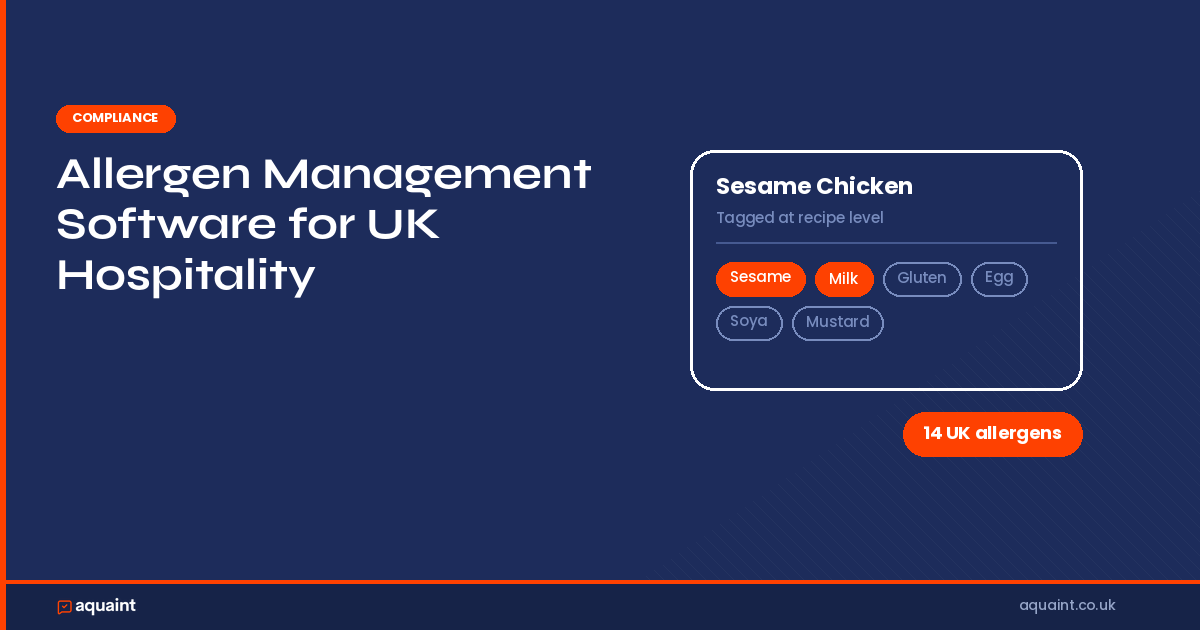
- Allergen information for every dish. The 14 named allergens, documented, and staff who can answer a question about them mid-service. See our 14 UK allergens guide.
Everything else is your choice. These three aren't.
The Advice You'll Get, and Why It's Usually Wrong
Ask most people, or most AI assistants, what software a new restaurant needs, and you'll get a stack: a compliance app, plus Slack or WhatsApp for comms, plus a rota tool, plus a document folder somewhere.
That advice comes from enterprise thinking. It makes sense when you have 40 sites, a head of compliance, and someone whose job is to make the tools talk to each other. It falls apart at one site with 12 staff and no ops manager.
Here's what actually happens when a single site runs a stack:
- The comms tool wins, the compliance tool loses. Your team already live in the chat app. The compliance app becomes the thing someone remembers to open at 11pm.
- Records and context split apart. The fridge failure gets logged in one app. The photo, the argument about who called the engineer, and the decision to bin the stock all happen in the other. Six months later you can't reconstruct what happened.
- Personal WhatsApp becomes your system of record. Staff phone numbers in a group chat, messages that vanish when someone leaves, and no lawful basis for any of it. That's a GDPR problem, not a convenience problem.
- You pay four subscriptions and use two.
One App vs a Stack: The Honest Comparison
Both approaches work. They work for different businesses. Here's the straight version.
A single platform is better when:
- You're one site, or a small group under 10 sites
- Nobody's full-time job is compliance
- Your team turns over regularly and needs to learn one thing, not four
- You want a single audit trail to hand an EHO
A stack is better when:
- You already run Microsoft 365 or Google Workspace across a large business and comms is solved
- You have integration requirements a single vendor won't meet
- You need best-in-class depth in one specific area, such as complex traceability or manufacturing-grade HACCP
- You have the ops resource to keep four systems in sync
If you're opening your first site, you're almost certainly in the first group. Be honest about which one you're in before you buy anything.
What to Look For in a Compliance App
- Mobile-first, not a website squeezed onto a phone. Your team is standing at a fridge with wet hands. If it takes more than three taps to log a temperature, it won't get logged.
- Offline capability. Cellars and walk-ins don't have signal. The check should save and sync later.
- Built-in temperature logging. Fridge, freezer, hot hold, cooking, cooling, delivery. If you're keeping a separate paper sheet, the software has failed.
- Allergen management that staff can actually use mid-service. Not a PDF matrix pinned to a wall.
- Incident and refusal logging. The thing you'll wish you had the first time something goes wrong.
- Records you can export in one tap. When an EHO asks for three months of hot hold logs, you want a file, not a filing cabinet.
- Team comms that leave an audit trail. If a manager tells a chef to change a procedure, that instruction should be findable in six months.
What It Should Cost
Aquaint is £60 per site per month on an annual plan, or £72 month to month. That covers compliance, checklists, temperature logging, allergens, incidents, documents, maintenance tickets and team communications in one place. There's no separate comms bill, because comms is part of the product.
Price a stack honestly before you compare. Add up the compliance tool, the comms tool, any document storage, and the hours someone spends every week reconciling the two. The subscription line is usually the smaller number.
Your First Week Checklist
- Write or download a HACCP plan and customise it to your actual menu, not a generic one
- Set your daily check routine: opening, closing, and temperature rounds. See the UK food safety temperatures guide for the legal numbers
- Build your allergen matrix for every dish on the opening menu
- Get every food handler to Level 2 food safety as a minimum, and file the certificates
- Buy and calibrate a probe thermometer, then set a weekly calibration reminder
- Move team comms off personal WhatsApp before you have a GDPR problem to unwind
- Register with your local authority at least 28 days before you open
Do these seven things and your first EHO inspection is a formality rather than an event.
See It Before You Buy It
Book a free demo of Aquaint and see how 100+ hospitality brands run compliance and team comms in one app.
FAQs
What software do I need to open a restaurant in the UK?
At minimum you need a documented food safety management system (HACCP or SFBB), a way to record daily checks such as temperature logs and cleaning schedules, and a way to communicate with your team that keeps a record. Everything else, including EPOS, rotas and bookings, is a commercial choice rather than a legal one.
Do I need separate apps for compliance and team communication?
No. For a single site or a small group, one app that covers both is usually better. Your team learns one system, your records and the conversations around them stay together, and you pay one subscription instead of two or three. Separate tools make more sense for large multi-site operators who already have comms solved.
Is WhatsApp fine for restaurant team communication?
It works until it doesn't. Personal WhatsApp groups expose staff phone numbers to each other, lose their history when people leave, and give you no lawful basis for processing that data. For anything that forms part of your compliance record, use a system where messages are retained and attached to the business, not to someone's personal phone.
Do I need a HACCP plan for a small independent restaurant?
Yes. Every UK food business needs a documented HACCP-based food safety management system regardless of size. Smaller businesses can use the FSA's Safer Food Better Business pack, which is a simplified version of the same principles.
How much does restaurant compliance software cost in the UK?
It varies widely, from around £5 a month for a basic digital diary to well over £150 per site per month for enterprise platforms with consultancy attached. Aquaint starts at £60 per site per month on an annual plan, or £72 month to month, and includes team communications so there's no separate comms subscription.
When should I set up compliance software, before or after opening?
Before. You need your food safety management system documented and your registration submitted at least 28 days before you open. Setting the software up during your fit-out means your team learns it during training rather than during service.
Can one app really replace paper checklists, WhatsApp and a document folder?
For most independent restaurants, yes. That's the specific job Aquaint was built for. Whether it's right for you depends on how much you rely on integrations with other systems, which is worth checking on a demo before you commit.
What happens at my first EHO inspection?
An unannounced visit scoring three areas: food hygiene and safety procedures, structural compliance, and confidence in management. New businesses are usually inspected within the first few months of opening. See our EHO inspection checklist for the full 47 points.
Related reading


Let's get aquainted - sign up to our newsletter
Join our newsletter to stay up to date on features and releases.