
Natasha's Law Explained: PPDS Labelling Rules (2026 Guide)
Last updated: October 2026
Natasha's Law means any food that is prepacked for direct sale (PPDS) must carry a label showing the name of the food and a full ingredients list, with each of the 14 allergens emphasised every time it appears. It has applied in all four UK nations since 1 October 2021. PPDS is food your business packs where it's sold, before the customer chooses it: the sandwich wrapped at 7am and sold at noon. Food packed after the customer orders doesn't need that label. For everything you don't prepack, the law still says allergen information must be available, and the FSA's best practice guidance recommends giving it in writing, backed by a conversation.
The law is named after Natasha Ednan-Laperouse, who died in 2016, aged 15, after an allergic reaction to sesame baked into a baguette. Its label didn't mention the sesame, because a loophole meant food made and packed where it was sold didn't need a full ingredients list (Hammersmith & Fulham Council). Natasha's Law closed that loophole.
This guide covers what counts as PPDS, what the label must show, the fines, and the written allergen information expected for the rest of your menu. For the 14 allergens themselves, see our 14 UK allergens guide.
What Is Natasha's Law?
"Natasha's Law" is the common name for four sets of amendments to food information law, one for each UK nation. All four came into force on 1 October 2021 (FSA technical guidance).
They all do the same job. PPDS food used to be treated like food served loose, so allergen information could be given verbally. Now it needs a label with its name, a full ingredients list and the allergens emphasised.
What Counts as PPDS Food?
The FSA defines PPDS as food "packaged at the same place it is offered or sold to consumers and is in this packaging before it is ordered or selected" (FSA, introduction to PPDS labelling).
So there are two tests. Did your business pack it where it's sold? And was it packed before the customer chose it? The "same place" can be:
- the same premises
- the same site, such as a shopping centre or an airport terminal
- your own market stall, marquee or food van, selling food you packed
| Example | PPDS? |
|---|---|
| Sandwiches and bakery items packed on site before customers choose them | Yes |
| A burger packed and held under a hot lamp before anyone orders it | Yes |
| Burgers and sausages a butcher prepacks on the premises | Yes |
| Food you pack and sell from your own market stall or food van | Yes |
| A sandwich made and wrapped after the customer orders it | No. Non-prepacked rules apply |
| A hot dog served on an open cardboard tray | No. The food can be altered without opening or changing the packaging |
| A pork pie packed by one business and sold by another | No. It's prepacked food, with fuller labelling rules |
Source: FSA technical guidance, paragraphs 94 to 100.
The Central Kitchen Question
This one catches out growing groups. The PPDS definition covers the same premises, the same site and your own mobile units. It doesn't mention a separate permanent site. So on the FSA's wording, food packed in your central kitchen and sold at another branch doesn't look like PPDS. If it isn't PPDS, it will usually count as prepacked food, which has fuller labelling rules.
The FSA's guidance doesn't tackle central kitchens head on. Agree your approach with your local authority's food team, or your Primary Authority if you have one, before you print a single label.
What Must a PPDS Label Show?
Three things, on every pack (FSA PPDS labelling guidance):
- The name of the food.
- A full ingredients list, including what's in your sauces and dressings.
- The 14 allergens emphasised every time they appear in that list, using bold, capitals, a contrasting colour or underlining.
Meat products also need the percentage of meat. The FSA says that for PPDS food, the quantitative ingredient declaration (QUID) "is only required for meat products".
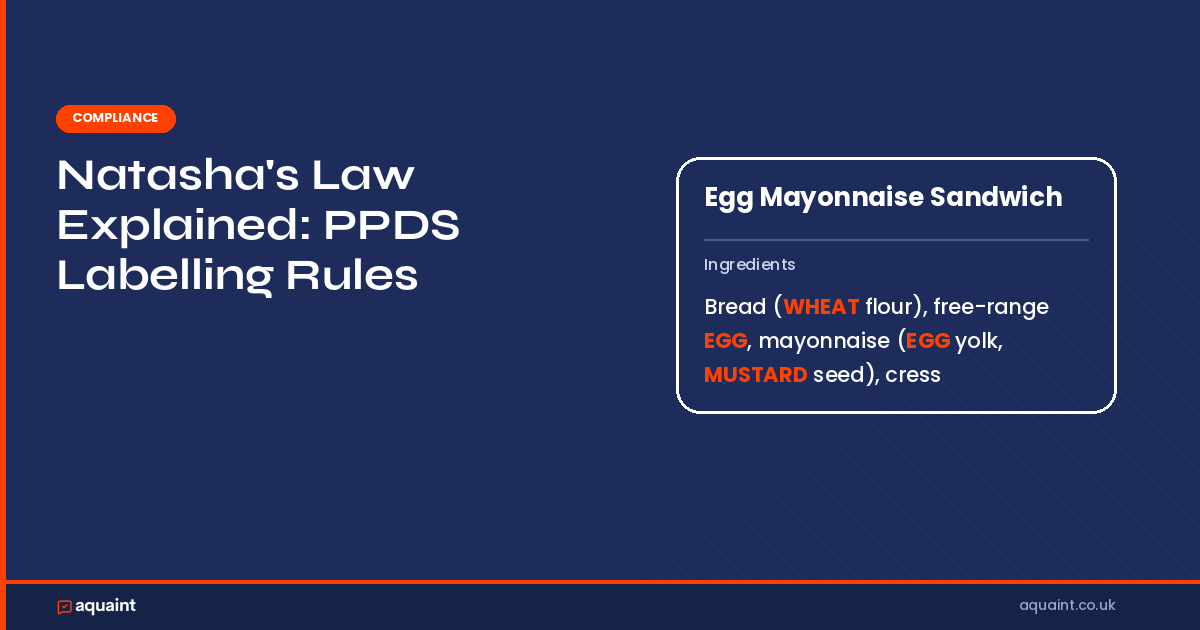
Here's a simplified example. Notice that egg is emphasised both times it appears:
Egg Mayonnaise Sandwich
Ingredients: bread (WHEAT flour, water, yeast, salt), free-range EGG, mayonnaise (rapeseed oil, water, EGG yolk, spirit vinegar, MUSTARD seed, salt), cress.
Does the Font Size Matter?
Yes. In England, the ingredients list on a PPDS label has to meet the minimum size in assimilated law (formerly retained EU law): an x-height of at least 1.2mm, or 0.9mm if the pack's largest surface is under 80cm² (SI 2019/1218, applying Article 13 of Regulation 1169/2011).
Handwritten labels are allowed, as long as they meet that size. In practice, legible handwriting at that size across a full lunchtime run is where mistakes creep in.
What About "May Contain" Labels?
Precautionary allergen labelling is voluntary. The FSA says to use it only when a risk assessment finds a risk of cross-contact that can't be removed. Blanket "may contain allergens" statements "could be deemed misleading", and you shouldn't put "may contain" next to a free-from claim for the same allergen (FSA precautionary allergen labelling guidance).
Does Natasha's Law Apply to Delivery and Online Orders?
Not the label part. When PPDS food is sold by distance selling, which the FSA says includes online takeaway aggregators, the PPDS label rule doesn't apply. You still have to give allergen information twice: before the customer completes the purchase, and when the food is delivered (FSA technical guidance, paragraphs 103 to 104).
The FSA's best practice guidance goes further for delivery. It recommends written allergen information "both before the food is ordered and when it is delivered", no more than "one click away" online, and clear directions on third-party platforms telling customers where to find it before they order. Stickers on the food, or a copy of the menu in the bag, cover the delivery end (FSA best practice guidance, paragraphs 46 to 49).
What Are the Fines for Breaking Natasha's Law?
Local authority food officers enforce the allergen rules. A breach can lead to an improvement notice, which you have 14 days to appeal, or a prosecution. Breaking allergen rules is a criminal offence, and on conviction a business is "liable to a potentially unlimited fine" (FSA technical guidance, paragraphs 105 to 108; FSA allergen guidance).
In England, the offence sits in the Food Information Regulations 2014. Breaching the PPDS allergen rule is an offence under regulation 10, and regulation 11 sets the fine at level 5 on the standard scale, which has had no upper limit since March 2015.
The fine isn't the biggest risk. A labelling mistake can put someone in hospital, or worse.
Do Restaurants Need Written Allergen Information?
Natasha's Law only covers PPDS food. Most of what a restaurant, pub or café serves is non-prepacked: cooked to order, served from a counter, poured at the bar. For that food the legal minimum hasn't changed. Allergen information must be available, and it can be given "by any means, including orally". If you rely on staff telling customers, you need a clear notice, menu note or label telling customers to ask (FSA technical guidance, paragraphs 80 to 81).
The guidance has moved on, though. In early 2025 the FSA published best practice guidance for non-prepacked food. Its core ask: "make allergen information easily available in writing for consumers and ensure staff are able to support this with a conversation" (paragraph 28). Ideally customers shouldn't have to ask for it (paragraph 37), and it should cover all 14 allergens (paragraph 29).
What that looks like in a venue:
- Written information for every dish, including specials and drinks, on the menu, a board or an allergen guide customers can see without asking.
- A conversation every time. The guidance suggests asking every customer whether they have any allergen requirements, or using a sign or menu message that prompts them to tell you (paragraph 66).
- Digital with a fallback. Apps and digital menus are fine if there's another way to get the information and a backup if the system fails (paragraphs 44 to 45).
It's guidance, not law. The FSA says so itself: "You are not required by law to follow best practice guidance." It does show where the rules are heading. The FSA scheduled a review of it for September 2026, and no revision had been published when we checked in October 2026.
Is Owen's Law Coming?
Owen Carey died on his 18th birthday in April 2017 after an allergic reaction to a meal at a London restaurant, where he had told staff about his allergies. His family's campaign, Owen's Law, asks for allergen information on the face of the main menu, for servers to always discuss allergies with customers, and for a national register of anaphylaxis deaths (Parliament petition 585304).
It isn't law. In June 2025 the government told the House of Lords that its evaluation of the voluntary guidance was likely to begin in spring 2026, to inform ministers on whether legislation is needed. The FSA's September 2026 board papers say the evaluation is under way and that "findings will inform the development and design of future legislation" (FSA Board, September 2026). No bill or legislative consultation has been published.
Scotland is moving too. Food Standards Scotland consulted from 23 February to 17 May 2026 on improving written allergen and ingredient information for non-prepacked food (Food Standards Scotland). It framed the proposals as possible changes to guidance and hasn't published the outcome.
Our read: written allergen information for every dish is heading towards law, though nobody has put a date on it, and Food Standards Scotland has so far preferred guidance. Venues that already provide it will be well placed whatever happens.
Why It Matters: The Gap Customers See
Around 6% of UK adults, about 2.4 million people, are estimated to have a clinically confirmed food allergy (FSA, 2024).
In the FSA's baseline research, 94% of food service workers said their business provides allergen information in writing. Yet 25% of adults with a food hypersensitivity said they didn't see any allergen information the last time they ate out or ordered a takeaway (FSA, October 2025). Those were separate surveys of workers and consumers, run before the guidance came out. The gap is still the point: information that exists isn't the same as information customers can see.
How Multi-Site Operators Keep Allergen Information Right
Natasha's Law is easy to meet on paper for one site with a short menu. It gets hard when a recipe changes and eight sites need new labels by tomorrow. The failure points are always the same:
- A supplier swaps a product and the new one contains an allergen the old one didn't.
- A chef tweaks a recipe and the label, the matrix and the menu don't follow.
- One site runs an old version of the allergen matrix for a fortnight.
- Labels are handwritten by whoever's on prep, and the ingredients list drifts.
The fix is one master record per recipe, held centrally, with every label, menu and matrix drawn from it and a dated history of every change. Our guide to allergen management software covers what to look for.
If you print PPDS labels in volume, a label printer that works from one central product list keeps every site's labels identical. Our partner Labl.it makes a handheld one, which it says is used in more than 4,000 UK kitchens.
A Natasha's Law Checklist
- List everything you pack before customers choose it. Mark each item PPDS, prepacked or non-prepacked.
- Build every PPDS label from the recipe, not from memory: name, full ingredients list, allergens emphasised every time, meat percentage for meat products.
- Check the print size: 1.2mm x-height, or 0.9mm on small packs (England).
- Lock down supplier swaps. No substitute goes into a dish until the recipe and the label are updated.
- Put written allergen information in front of customers for everything else, including specials and drinks.
- Train every server to ask about allergies and to know exactly where the information is.
- For online and phone orders, give allergen information before the order and with the delivery.
- Use "may contain" only after a risk assessment.
- Keep dated records: recipe versions, label versions, staff training, allergen incidents and near misses.
What Venues Use to Keep These Records
You can run all of this on spreadsheets and printed matrices, and plenty of single sites do. The weak point is version control: proving which version of a recipe a site was serving on a given day, and that every site had it.
Aquaint holds allergen data at recipe level, inside the same app as your temperature logs, checklists and incident reports. Build the allergen matrix once at head office and every site works from the same version. Update a dish once and the change reaches every site. Front of house can search a dish on their phone during service, and you can pull a dated allergen record when an inspector asks. Pricing is on the pricing page.
Get Your Allergen Records Inspection-Ready
Book a demo and we'll set up allergen tagging on a few of your own dishes, so you can judge it properly.
FAQs
What is Natasha's Law?
Natasha's Law is the name for UK rules, in force since 1 October 2021, that require food prepacked for direct sale (PPDS) to carry a label with the name of the food and a full ingredients list, with the 14 allergens emphasised. It's named after Natasha Ednan-Laperouse, who died in 2016 after an allergic reaction to sesame in a baguette whose label didn't mention it.
Does Natasha's Law apply to restaurants?
Only to food a restaurant packs before customers order it, such as grab-and-go sandwiches or salads. Food cooked to order is non-prepacked. It doesn't need a label, but allergen information must still be available, and the FSA's best practice guidance recommends giving it in writing, backed by a conversation.
What must be on a PPDS label?
The name of the food and a full ingredients list, with each of the 14 allergens emphasised every time it appears, for example in bold. Meat products also need the percentage of meat. In England, the ingredients list must have an x-height of at least 1.2mm, or 0.9mm on packs whose largest surface is under 80cm².
What is the fine for breaking Natasha's Law?
Council food officers can serve an improvement notice, and breaking allergen rules is a criminal offence. In England, a conviction can mean a fine with no upper limit.
Is written allergen information a legal requirement for restaurants?
Not yet. For non-prepacked food, the law allows allergen information to be given verbally, as long as a notice or menu tells customers to ask. The FSA's 2025 best practice guidance recommends written information for every dish, backed by a conversation, and the FSA says its evaluation of that guidance will inform future legislation.
Does Natasha's Law apply to takeaway delivery?
The PPDS label rule doesn't apply to food sold by distance selling, such as through online takeaway aggregators. Allergen information must still be given before the customer completes the order and again when the food is delivered.
Can PPDS labels be handwritten?
Yes, as long as they include everything a PPDS label needs and meet the legal minimum font size.
What is Owen's Law?
Owen's Law is a campaign named after Owen Carey, who died in 2017 after an allergic reaction to a restaurant meal. It asks for allergen information on the face of every main menu, for servers to always discuss allergies, and for a national register of anaphylaxis deaths. It isn't law, and no bill has been published.
Related reading





Let's get aquainted - sign up to our newsletter
Join our newsletter to stay up to date on features and releases.