

14 UK Allergens: The Complete Guide (2026)
Last updated: April 2026
One unlogged ingredient. One missed dish change. One agency server who didn't know the chef swapped butter for tahini last week.
That's how allergen incidents happen. Not from bad intent - from broken process.
Every UK hospitality venue is sitting on the same three legal duties:
- Declare the 14 major allergens in every dish, accurately (Food Standards Agency guidance).
- Label all prepacked for direct sale (PPDS) food in full (Natasha's Law, in force since October 2021).
- Prove you can handle an allergen request safely - training, records, and controls the EHO can see.
This guide walks through all 14 allergens, what each one looks like on your menu, and the controls that turn compliance from a liability into a competitive edge.
The 14 allergens you must declare
UK law requires every food business to declare these 14 allergens, every time they appear. The list comes from Regulation (EU) No 1169/2011 (retained in UK law after Brexit):
Celery - Celery salt, stock cubes, bouillon, marinades
Cereals containing gluten - Wheat, rye, barley, oats, spelt, khorasan - and anything made from them (bread, pasta, sauces, soy sauce)
Crustaceans - Prawns, lobster, crab, langoustine - and stocks/oils that contain them
Eggs - Mayonnaise, pasta, pastries, glazes, some wines, many dressings
Fish - Fresh and preserved fish, fish sauce, Worcestershire sauce, Caesar dressing, some pizza toppings
Lupin - Lupin flour/seeds in some breads and pastries (more common in European imports)
Milk - Butter, cheese, cream, yoghurt, whey, casein, ghee - and traces in many processed foods
Molluscs - Mussels, oysters, squid, octopus, snails, scallops
Mustard - Mustard seeds, leaves, powder - and many salad dressings, marinades, curries
Tree nuts - Almonds, hazelnuts, walnuts, cashews, pecans, Brazil nuts, pistachios, macadamias
Peanuts - A legume, not a nut - but treated as its own allergen. Check oils, satay, baked goods
Sesame - Tahini, hummus, sesame oil, burger buns, halva
Soybeans - Soy sauce, tofu, edamame, miso, many vegan substitutes, emulsifiers (lecithin)
Sulphur dioxide / sulphites (>10 mg/kg) - Wine, beer, dried fruit, some pre-cut potatoes, pickles
Keep this list accessible to every front-of-house and kitchen team member, updated every time a supplier or recipe changes.
Natasha's Law, in plain English
Since October 2021, any food prepacked for direct sale (PPDS) must carry a label showing:
- The name of the food
- A full ingredients list
- The 14 allergens emphasised (usually bold) within that list
PPDS covers food packed at the same place it's sold before the customer orders it - the grab-and-go sandwich in the fridge, the pre-boxed salad on the counter, the cookie wrapped for the till display.
Food made to order and handed over directly (the plated burger, the cocktail, the pizza fresh from the oven) doesn't need a PPDS label - but you still need to give accurate allergen information when asked.
Natasha's Law came in after 15-year-old Natasha Ednan-Laperouse died in 2016 from an allergic reaction to an unlabelled sesame baguette. It exists because this stuff matters. The Natasha Allergy Research Foundation continues to campaign for better allergen safety.
Where most venues go wrong
We've worked with 100+ UK hospitality brands on allergen compliance. These are the five failure modes we see most:
1. The recipe changed, the matrix didn't.
Chef swaps rapeseed oil for sesame oil to save money. Nobody updates the allergen matrix. Two weeks later, a customer has a reaction.
2. The agency server didn't get the brief.
New starter on a busy Friday. Manager forgets to walk them through the allergen system. Customer asks about dairy. Server guesses. Wrong guess.
3. The "nut-free" kitchen isn't.
You don't cook with nuts. Your bread supplier changed mills and now uses a line that handles sesame. The "may contain" label on their bag was missed on delivery.
4. PPDS labels are half-done.
The chef labels today's sandwich with the allergens from last week's recipe. Ingredients shifted, labels didn't.
5. Training is a box-tick, not a behaviour.
Everyone's done the online module. Nobody can find the allergen folder in under 30 seconds when an EHO asks.
Each of these is a process problem. None are solved by working harder - they're solved by building allergen handling into daily operations.
The five controls every venue needs
1. A live allergen matrix.
One source of truth. Every dish, every allergen, updated the moment a recipe or supplier changes. Not a printout from six months ago.
2. A PPDS labelling process.
Who writes the labels. What template. What happens when the recipe changes. How the labels are checked before the food hits the shelf.
3. Trained staff who can find the information in under 30 seconds.
Every team member - agency, casual, full-time - knows where the allergen information lives, how to read it, and what to say when a customer asks. The FSA's free allergen training is a sensible baseline.
4. Supplier and delivery controls.
New suppliers get their allergen data logged before a single dish goes out. Every delivery is checked for "may contain" changes. Reformulations trigger a matrix review.
5. An incident log.
Every allergen query, near-miss or reaction gets recorded. Not to cover yourself - to learn from, and to show the EHO you're running a tight ship. This ties directly into your HACCP plan.
The allergen question every EHO will ask
If an EHO walks in and asks a random team member:
"A customer says they have a severe sesame allergy. What do you do?"
You want the answer to come back fast, confident, and correct:
"I'd tell them I'll check the allergen information for them. I'd look it up in the allergen folder behind the till - it's also on the tablet in the kitchen. If anything on their order contains sesame or we can't guarantee no cross-contact, I'd tell them. If it's safe, I'd still flag it with the chef before sending the order."
If you get "I'd have to check with the chef" and a shrug - that's a confidence-in-management hit on your EHO score.
How Aquaint handles allergens
Most of what's above sounds simple. It isn't - because it has to work across every site, every shift, every new starter.
Aquaint bakes allergen handling into daily operations:
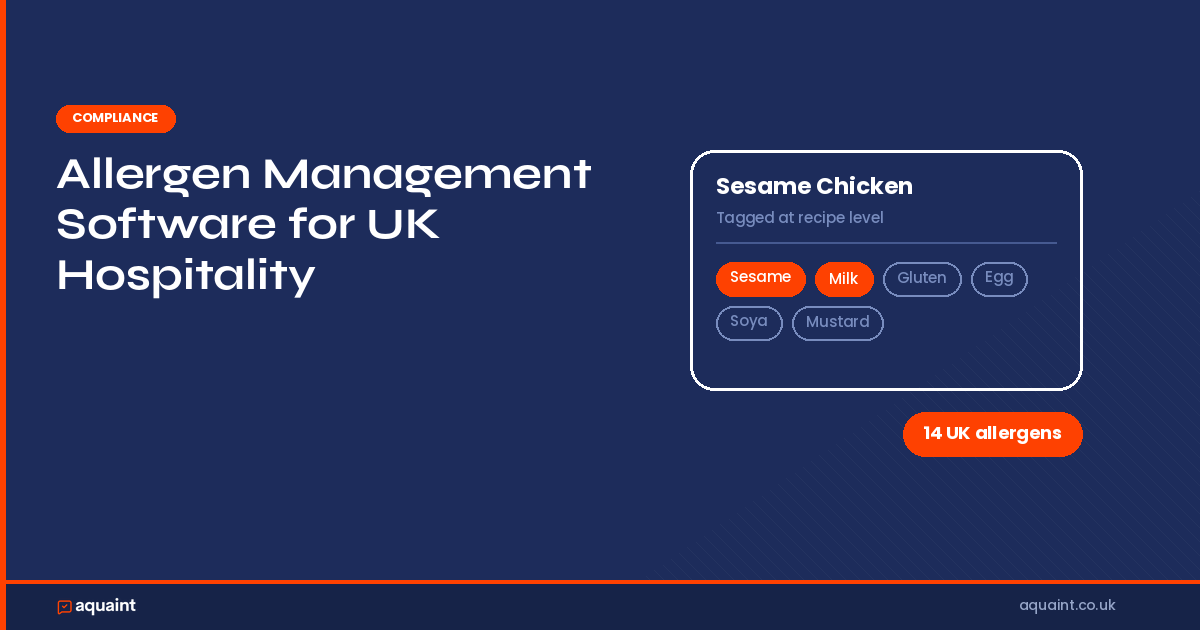
- Digital allergen matrix, linked to every dish, visible on every team member's phone
- PPDS label workflow with required fields, recipe-linked, with sign-off before labels print
- Supplier and recipe change alerts so updates propagate to every site instantly
- Training records logged per team member, with expiry dates
- Allergen incident log - every query, refusal and near-miss captured with a timestamp
- EHO-ready export - pull your full allergen audit trail in one tap from reporting
One app. One matrix. Every site. No more "I thought chef told you."
FAQs
What are the 14 allergens by UK law?
Celery, cereals containing gluten, crustaceans, eggs, fish, lupin, milk, molluscs, mustard, tree nuts, peanuts, sesame, soybeans, and sulphur dioxide/sulphites.
Is peanut a tree nut?
No. Peanut is a legume. It's its own allergen category under UK law.
What counts as PPDS?
Food packed on the same premises where it's sold, before the customer orders it. Think grab-and-go sandwiches, pre-boxed salads, wrapped cookies at the till.
Do I need to label every dish on my menu?
No. Made-to-order food handed over directly to the customer doesn't need a label - but you must give accurate allergen information on request.
What's the fine for getting this wrong?
Unlimited. And that's before civil claims and reputational damage. Two UK venues have been charged with manslaughter after allergen-related deaths.
How often should I retrain staff?
At minimum annually - but re-train immediately after any recipe change, supplier change, or new starter joining the team.
Where can I find more official guidance?
The Food Standards Agency allergen hub is the authoritative source for UK food businesses.
Related reading




Let's get aquainted - sign up to our newsletter
Join our newsletter to stay up to date on features and releases.