
Allergen Compliance in Hospitality: Your Complete Guide
Last updated: May 2026
Every year in the UK, around 10 people die from food-induced anaphylaxis. Thousands more have serious allergic reactions. For hospitality businesses, getting allergen compliance wrong is not a paperwork issue. It is a life-or-death responsibility.
And yet, allergen management remains one of the most common areas where venues fall short during inspections.
This guide covers everything you need to know about allergen compliance in hospitality, from the legal requirements to the practical steps that keep your customers safe and your venue on the right side of the law.

The Legal Framework: Natasha's Law and Beyond
Allergen labelling in the UK changed significantly on 1 October 2021, when Natasha's Law came into effect. Named after Natasha Ednan-Laperouse, who died in 2016 after eating a Pret a Manger baguette containing sesame, the law tightened requirements for prepacked for direct sale (PPDS) food.
Under Natasha's Law, any food that is prepacked on the same premises where it is sold must carry a full ingredients list with the 14 major allergens emphasised. This includes items like sandwiches made in-house and wrapped for display, salads prepared and packaged for a grab-and-go counter, and cakes or pastries wrapped on site.
But Natasha's Law is only part of the picture. The Food Information Regulations 2014 (FIR) already require all food businesses to provide allergen information for non-prepacked food. That means anything served from a menu, specials board, or buffet needs clear allergen communication.
There is no excuse for not knowing which allergens are in your dishes. The law requires it. Your customers depend on it.
The 14 Allergens You Must Declare
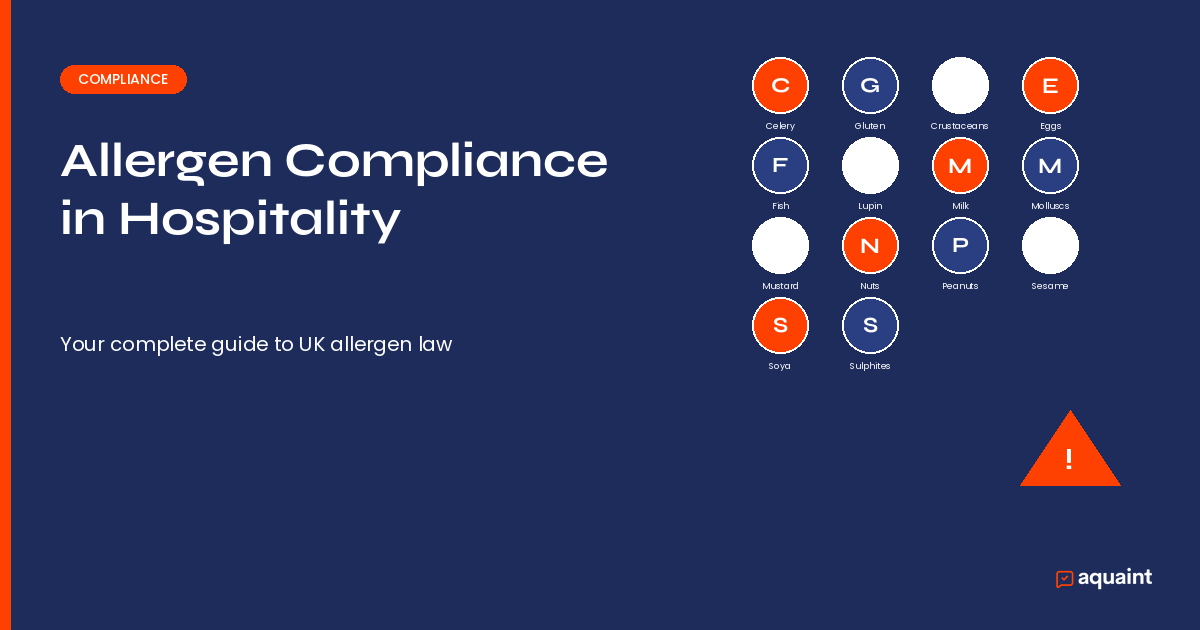
UK law requires food businesses to declare the presence of 14 specific allergens. We have a dedicated guide covering all 14 UK allergens in detail, but here is the full list:
- Celery (including celeriac)
- Cereals containing gluten (wheat, rye, barley, oats)
- Crustaceans (prawns, crab, lobster)
- Eggs
- Fish
- Lupin
- Milk
- Molluscs (mussels, oysters, squid)
- Mustard
- Tree nuts (almonds, hazelnuts, walnuts, cashews, pecans, brazils, pistachios, macadamias)
- Peanuts
- Sesame
- Soya
- Sulphur dioxide and sulphites (at concentrations above 10mg/kg or 10mg/litre)
These 14 allergens must be identifiable at the point of sale. How you communicate them depends on how the food is served, but the information must be accurate and accessible.
Where Venues Get Allergen Compliance Wrong
After working with over 100 hospitality brands, we see the same allergen compliance failures again and again. Here are the most common:
Outdated allergen information
Menus change. Suppliers change. Recipes evolve. But the allergen matrix pinned to the kitchen wall? That was printed six months ago and no longer reflects what you are serving. This is the single biggest allergen compliance risk in hospitality.
Relying on verbal communication alone
"Ask a member of staff" is not a compliance strategy. Yes, staff should be trained to answer allergen questions. But relying entirely on verbal communication means one new starter who has not been briefed, or one busy Saturday night with a miscommunication, could result in a serious incident.
Cross-contamination blind spots
You might know exactly what is in every dish. But do you know what happens when the same tongs are used for the gluten-free and standard options? Or when a chopping board is not properly cleaned between preparations? Cross-contamination procedures need to be documented and followed.
No process for menu changes
A chef swaps one brand of sauce for another. The new brand contains mustard. Nobody updates the allergen information. This happens more often than anyone in the industry would like to admit.
Poor record keeping
When an EHO asks to see your allergen management records during an inspection, "we do it but we do not write it down" will not earn you any points in the confidence in management category.
Why Paper Allergen Matrices Fail
The traditional approach to allergen management is a printed matrix. A grid showing each menu item against the 14 allergens, with ticks or crosses. It looks organised. It feels compliant. But it has fundamental problems.
Paper matrices become outdated the moment anything changes. A new dish gets added to the specials board but nobody updates the matrix. A supplier changes the formulation of a sauce. A seasonal menu launches but the old matrix is still on the wall.
They cannot track who checked what, or when. There is no audit trail. You cannot prove that the information was reviewed, that staff were informed of changes, or that anyone verified the data against actual supplier specifications.
Multi-site consistency is almost impossible. If you run more than one location, keeping paper matrices synchronised across all sites is a full-time job that nobody has time for. One site updates, another does not, and you end up with different allergen information for the same dishes.
They get lost, damaged, or ignored. Paper in a kitchen environment does not last. It gets splashed, stained, ripped down, or buried under other notices. We have visited venues where the allergen matrix was technically on site but nobody could find it.
If you are still managing allergens on paper, the question is not whether something will go wrong. It is when. For a broader look at this problem, read our comparison of paper versus digital compliance.
Managing Allergens Digitally
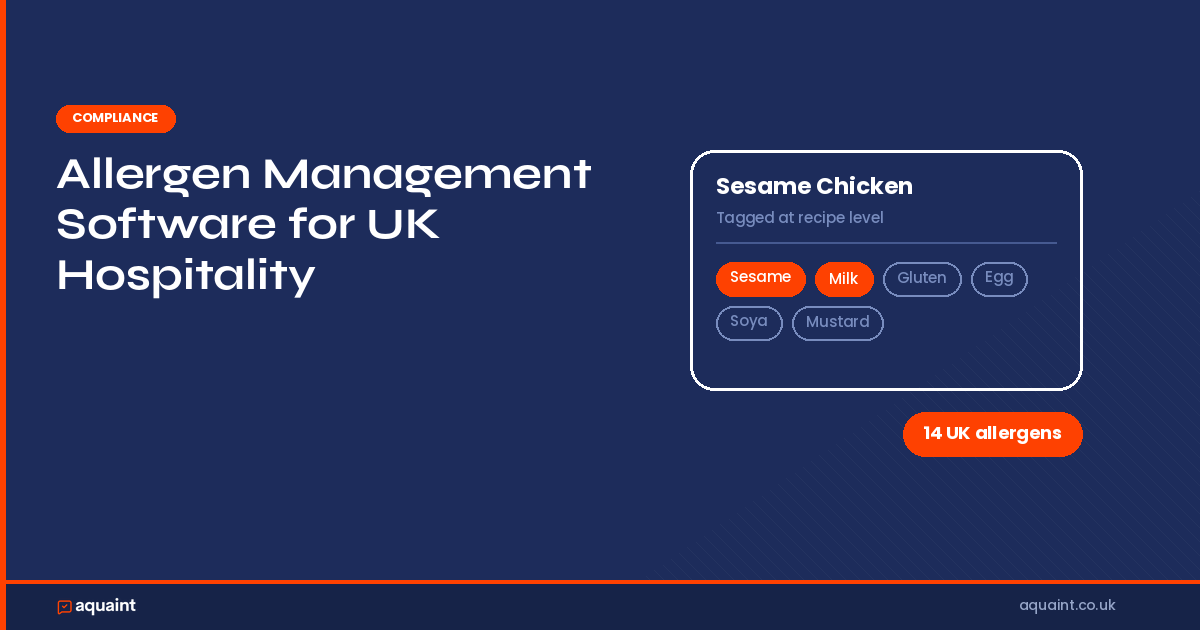
Digital allergen management fixes the core problems with paper. With Aquaint's allergen module, you enter your menu items directly into the system and tag each one with its allergen information. When a recipe changes, you update it once and every site sees the change immediately.
Here is what that looks like in practice:
- Centralised menu management - Enter each dish with its ingredients and allergen tags. Update once, and the information flows to every location.
- Real-time accuracy - When a supplier changes a product or a recipe is modified, the allergen data gets updated at the source. No reprinting. No hoping someone remembers to swap the old sheet for the new one.
- Accessible on any device - Staff can check allergen information from the floor using their phone. No walking back to the kitchen to check a laminated sheet.
- Audit trail - Every update is logged with a timestamp and user. When an EHO asks about your allergen management process, you can show exactly when information was last reviewed and by whom.
- Staff acknowledgment - Push updates to your team when allergen information changes. Track who has seen and acknowledged the update.
This is not about replacing the conversation between a server and a customer asking about allergens. That conversation should still happen. But the information behind it needs to be accurate, current, and verifiable.
Training Your Team on Allergen Compliance
Allergen training is not a tick-box exercise you complete at induction and forget about. Every team member who handles food or takes orders needs to understand:
- What the 14 allergens are and where they commonly appear
- How to respond when a customer declares an allergy
- Your venue's cross-contamination procedures
- Where to find accurate allergen information for every dish
- What to do if they are unsure about an ingredient
- The difference between an allergy, an intolerance, and a preference
The rule should be clear: if you do not know, do not guess. Check the system, ask the kitchen, or speak to a manager. A confident but wrong answer is far more dangerous than admitting uncertainty.
Refresher training should happen whenever the menu changes significantly, when new allergen-related legislation is introduced, or at least quarterly as standard practice.
Allergen Compliance and Your EHO Score
Allergen management directly affects your food hygiene rating. It falls across multiple scoring categories:
- Food hygiene and safety - Are allergens being managed to prevent cross-contamination?
- Confidence in management - Do you have documented allergen procedures? Are they followed consistently?
An EHO will typically ask to see your allergen information for specific dishes, check whether staff can explain your allergen procedures, look at how you handle cross-contamination risks, and review your documentation. Venues using a digital system that can demonstrate real-time allergen data, training records, and update logs consistently score higher in confidence in management. It shows you are not leaving things to chance.
For more on what EHOs look for and how to prepare, read our full EHO inspection guide.
Building an Allergen Culture, Not an Allergen Checklist
The best venues do not treat allergen compliance as a box to tick. They build it into how the team operates every day.
That means kitchen briefings that cover allergen changes when new dishes launch. It means servers who ask about allergies as a standard part of taking orders, not as an afterthought. It means a culture where flagging an uncertainty is encouraged, not seen as slowing things down.
Technology supports this culture. When allergen information is always accessible, always current, and always auditable, your team can focus on the human side of allergen management. The conversations, the care, the attention to detail that keeps customers safe.
Getting allergen compliance right is not complicated. It takes a clear system, consistent training, and the discipline to keep information accurate. The tools exist. The question is whether your venue is using them.
Frequently Asked Questions
Do I need to declare allergens for drinks as well as food?
Yes. Allergen declarations apply to all food and drink you serve, including alcoholic beverages. Wine and beer can contain sulphites, milk, eggs, and cereals containing gluten. Cocktails may contain nut-based liqueurs or milk. Every drink on your menu needs allergen information available.
What happens if a customer has an allergic reaction at my venue?
First, call 999 immediately if the reaction is severe. Administer an adrenaline auto-injector (EpiPen) if the customer has one and is unable to do so themselves. Record every detail of the incident, the dish served, the allergen involved, who prepared and served the food, and the timeline. Report the incident to your local authority. You may also need to make a RIDDOR report depending on the severity.
Is "may contain" labelling required by law?
"May contain" warnings are not required by UK law. They are voluntary statements used to communicate cross-contamination risk. However, you cannot use "may contain" as a substitute for proper allergen management. If cross-contamination is a known risk, you need to either control it through your processes or communicate it clearly to customers.
How do I handle allergens for specials or off-menu items?
Specials and off-menu items need the same level of allergen information as your regular menu. Before any dish is served, its allergen profile must be known and communicable. If a chef creates a special, the allergen information should be documented before the first portion leaves the kitchen. Digital systems make this easier since you can add new items in seconds.
Can I refuse to serve a customer with severe allergies?
Legally, you are not obligated to serve a dish to a customer if you cannot guarantee their safety. If your kitchen cannot safely prepare an allergen-free meal due to cross-contamination risks, it is better to be honest than to take a chance. Communicate clearly, offer alternatives where possible, and never pressure a customer to accept a risk. Document any refusal and the reason behind it.




Let's get aquainted - sign up to our newsletter
Join our newsletter to stay up to date on features and releases.