
Allergen Management Software for UK Hospitality
Last updated: August 2026
Allergen management software tags every dish on your menu against the 14 named UK allergens, makes that information searchable by front of house during service, and keeps a dated record proving the data was current. For UK hospitality it needs to do four things: hold allergen data at recipe level so it survives a menu change, be usable on a phone in under thirty seconds mid-service, stay consistent across every site, and produce records an EHO will accept as due diligence evidence. A spreadsheet does the first. It rarely does the other three.
The scale of the problem is bigger than most operators assume. The FSA's Patterns and Prevalence of Adult Food Allergy study estimates around 2.4 million UK adults, roughly 6% of the population, live with a clinically confirmed food allergy (Food Standards Agency). More than 30% report some form of food hypersensitivity. On a busy Saturday service, that is not a rare edge case.
What UK Law Actually Requires
Fourteen allergens must be declared: celery, cereals containing gluten, crustaceans, eggs, fish, lupin, milk, molluscs, mustard, tree nuts, peanuts, sesame, soybeans, and sulphur dioxide or sulphites above 10mg per kg or litre.
How you declare them depends on the food:
- Prepacked for direct sale (sandwiches made in the morning, salads in a chiller): full ingredient list on the label with allergens emphasised. This is Natasha's Law, in force since October 2021.
- Non-prepacked (a dish cooked to order): no label needed, but the information must be available and a member of staff has to be able to give it.
The legal duty is not just to hold the information. It is to communicate it accurately, every time, by whoever happens to be on shift.
What Allergen Software Has to Do
Judge any tool on these six things.
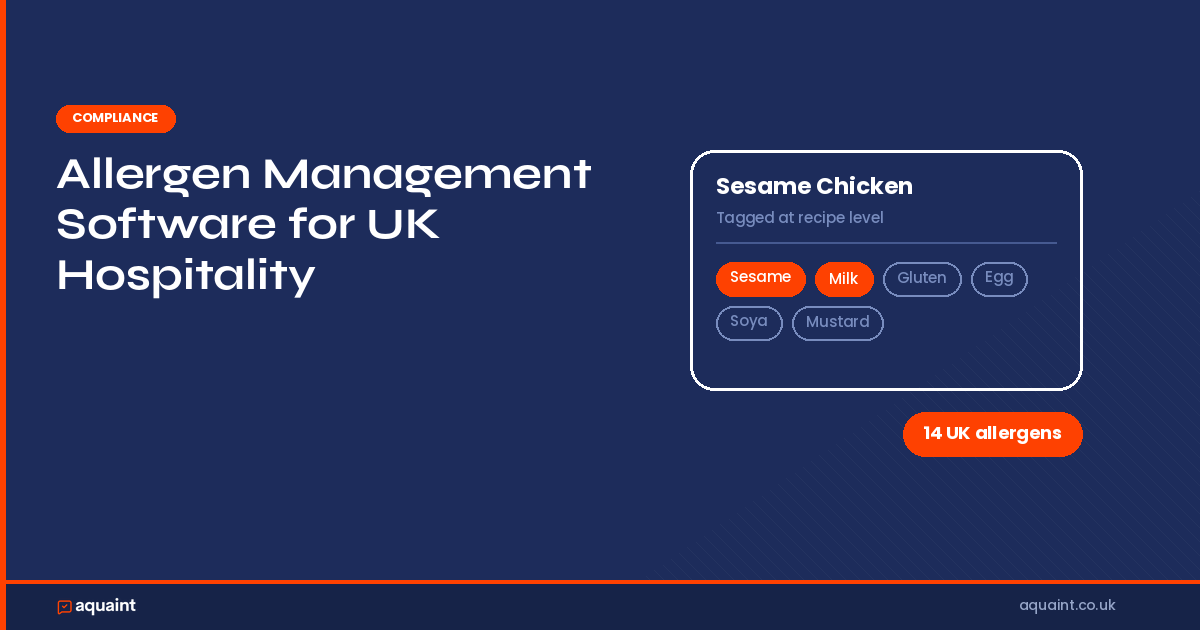
- Tag at recipe level, not menu level. If allergens are attached to a menu PDF, the data goes stale the moment a chef swaps an ingredient. Attach them to the recipe and the tag follows the dish wherever it appears.
- Update from supplier specifications. Most allergen failures start with a supplier reformulating a product and nobody noticing. Your system needs somewhere to hold the spec and a way to flag when it changes.
- Work on the floor, on a phone. A matrix pinned to the office wall is useless at table 14. A server should be able to search a dish and get an answer without finding the head chef.
- Stay identical across sites. Central data pushed out, not local copies maintained per venue.
- Record who knew what, and when. Version history on the matrix, dated training sign-offs, logged incidents. That is what due diligence looks like in practice.
- Cover cross-contamination controls. Segregation, separate equipment, cleaning between preparation. Allergen management is a kitchen process, not only a data problem.
The Front of House Test
Here is the only test that matters. A guest asks whether a dish contains sesame. Your newest server has been with you nine days. It is 8pm on a Saturday.
Can they answer accurately in under thirty seconds, without leaving the floor?
If the answer is "they'd go and ask the chef", your allergen system has a single point of failure who is currently plating twelve covers. Most allergen incidents are not caused by a team that did not know the rules. They are caused by information that was not reachable at the moment it was needed.
Multi-Site: Where It Usually Breaks
One site is a data problem. Ten sites is a version control problem.
The common failure is each venue keeping its own spreadsheet. A recipe changes centrally, eight sites update, two do not, and for a fortnight two of your venues are giving out allergen information that is wrong. Nobody finds out until someone reacts.
Central allergen data with a forced push to every site removes that gap. If you operate more than one venue, this is the single biggest reason to move off spreadsheets.
Proving Due Diligence
If something goes wrong, the due diligence defence depends on showing you had a system and were following it. In allergen terms that means:
- An allergen matrix with a version history, so you can show what it said on the day
- Supplier specifications for every ingredient
- Dated training records for every person who handled or served food
- Logged allergen incidents and near misses, with what you did about them
Undated records prove very little. "We always do this" is not evidence. A timestamped record is.
When You Don't Need Software
Being straight about this. A single site with a short, stable menu and a long-serving team can run allergen management on a well-maintained spreadsheet and a printed matrix. Plenty do, and pass inspections comfortably.
Software earns its place when one of these is true:
- Your menu changes often, or you run specials
- You operate more than one site
- Your team turns over regularly
- You are prepacking for direct sale and need labels to match the recipe
- You cannot currently produce a dated allergen record from six months ago in under a minute
If none of those apply, keep your spreadsheet and spend the money elsewhere.
How Aquaint Handles Allergens
Allergen tracking sits inside the same app as your temperature logs, checklists, incident reports and team messages, so the allergen matrix and the conversation about a recipe change live in one place rather than two systems.
Tag dishes at recipe level, push updates to every site at once, let front of house search on their phone during service, and pull a dated allergen record when an inspector asks. Pricing is on the pricing page, with no separate module fee for allergens.
See It on Your Own Menu
Book a free demo and we'll set up allergen tagging against a few of your actual dishes so you can judge it properly.
FAQs
What app tags menu items with allergens?
Allergen management software lets you tag every dish against the 14 named UK allergens at recipe level, so the tag follows the dish everywhere it appears. Look for tools that hold allergen data per ingredient rather than per menu, because that is what stops the information going stale when a supplier changes a product. Aquaint does this as part of the core app.
Can an app flag allergens instantly for front of house?
Yes. The useful test is whether a server can answer a guest question in under thirty seconds without leaving the floor or finding the head chef. That means the allergen matrix has to be searchable on a phone, current by default, and readable by someone who started last week.
What allergens must be declared under UK law?
Fourteen: celery, cereals containing gluten, crustaceans, eggs, fish, lupin, milk, molluscs, mustard, tree nuts, peanuts, sesame, soybeans, and sulphur dioxide or sulphites above 10mg per kg or litre.
What are the allergen labelling rules for prepacked food?
Food prepacked for direct sale must carry a label showing the full ingredient list with the 14 allergens emphasised, usually in bold. This is the requirement introduced by Natasha's Law in October 2021. Food made to order and handed straight to the customer does not need a label, but the allergen information must still be available.
How do I keep allergen records for a UK food business?
Keep a dish-level allergen matrix, supplier specifications for every ingredient, records of your allergen cleaning and segregation procedures, and dated staff training records. An inspector will want to see that the matrix matches the menu currently being served, which is where paper systems usually fail.
What allergen records prove due diligence?
Records that show a system was in place and being followed at the time of an incident: a current allergen matrix with a version history, supplier specifications, dated staff training sign-offs, and logs of allergen-related incidents and how they were handled. Undated records are weak evidence.
How do multi-site restaurants keep allergen info consistent?
Hold allergen data centrally and push it to sites, rather than letting each site maintain its own copy. When a recipe or supplier changes, the update should reach every venue at once. Local spreadsheets are the most common cause of one site serving a dish with out-of-date allergen information.
How can restaurants reduce allergen mistakes?
Most incidents come from a communication gap rather than a knowledge gap. Reduce them by keeping allergen data current at recipe level, making it searchable on the floor during service, giving every team member a fixed procedure for allergen orders, and logging near misses so patterns become visible.
Related reading
- 14 UK Allergens: The Hospitality Team's Guide
- Due Diligence Defence: What UK Food Businesses Need to Know
- HACCP Plan Template for UK Hospitality (Free PDF)
- EHO Inspection Checklist: How to Get 5 Stars
- UK Food Safety Temperatures: The FSA Chart + Checklist
- Paper vs Digital Compliance: Why Your Team Needs Digital



Let's get aquainted - sign up to our newsletter
Join our newsletter to stay up to date on features and releases.