
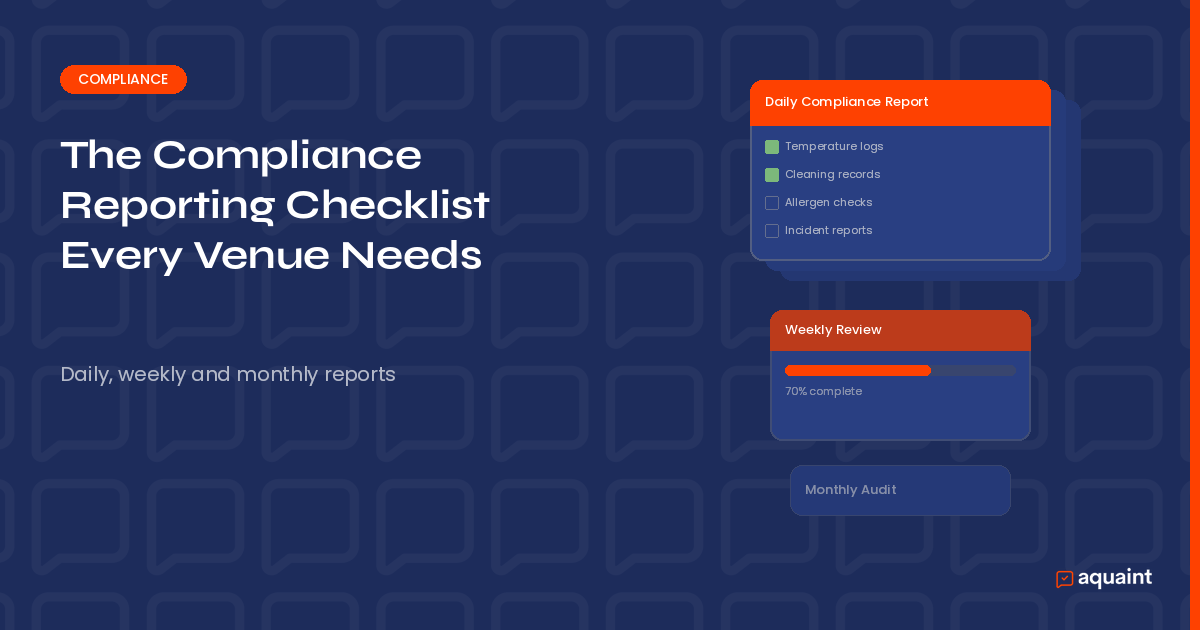
Compliance Reporting Checklist for Hospitality
Last updated: April 2026
Compliance reporting in hospitality isn't a single report. It's a system of daily, weekly, and monthly records that together prove your venue operates safely and consistently. Miss one piece, and the whole picture falls apart - usually at the worst possible moment, like during an EHO inspection or an insurance claim.
This checklist breaks down exactly what you should be recording, how often, and why it matters.
Daily Compliance Reports
These are the non-negotiables. If you're not recording these every single day, you have gaps in your compliance trail.
Temperature Logs
What to record: Fridge temperatures (must be below 8 degrees C), freezer temperatures (must be below -18 degrees C), hot holding temperatures (must be above 63 degrees C), and delivery temperatures for all incoming food supplies.
How often: At least twice daily for fridges and freezers - once at opening and once mid-service. Delivery temperatures at the point of receipt for every delivery.
Why it matters: Temperature abuse is the single most common cause of foodborne illness. An EHO inspector will ask for your temperature records first. Gaps or inconsistent readings immediately flag poor management. See our food safety temperatures guide for the exact ranges required.
What most venues get wrong: Recording temperatures on paper and filing them in a drawer. When an inspector asks for February's records in July, you need to produce them. Digital temperature logging with automated timestamps removes the risk of lost paperwork and backdated entries.
Task Completion Records
What to record: All scheduled compliance tasks - opening checks, closing checks, cleaning schedules, food prep procedures, allergen checks, probe calibration. Each entry should capture who completed the task, when, and whether any issues were found.
How often: Every task, every shift, every day.
Why it matters: Task completion records are your evidence that procedures are being followed, not only written down. An EHO inspector assessing "confidence in management" is essentially asking: does this team do what their procedures say they do?
Cleaning Schedules
What to record: Which areas and equipment were cleaned, by whom, when, and which cleaning chemicals were used. Include deep-clean schedules for less frequent tasks (extract canopy cleaning, drain maintenance, behind-equipment cleaning).
How often: Daily for routine cleaning, with weekly and monthly deep-clean records.
Why it matters: The Food Safety Act 1990 requires premises to be kept clean and maintained in good condition. Your cleaning schedule is the evidence trail. Signed, dated entries beat a generic checklist that's been photocopied and ticked without thought.
Weekly Compliance Reports
HACCP Monitoring
What to record: Evidence that your HACCP plan's critical control points (CCPs) are being monitored effectively. This includes temperature checks at CCPs, corrective actions taken when limits were breached, and any changes to processes or suppliers that affect your HACCP plan. Refer to the FSA's HACCP guidance for detailed requirements.
How often: Weekly review of HACCP monitoring records. The daily data feeds into this, but a weekly review catches patterns - for example, if the same fridge keeps hitting 7.5 degrees C every afternoon, that's a maintenance issue, not a one-off.
Why it matters: HACCP compliance isn't optional for food businesses. A documented, actively monitored HACCP plan is a legal requirement. An outdated or purely theoretical plan is worse than having no plan - it shows you don't take it seriously.
Incident and Near-Miss Review
What to record: All incidents from the past week - accidents, near misses, food safety complaints, refusal logs. For each, record what happened, what corrective action was taken, and whether it's part of a pattern.
How often: Weekly management review, with individual incidents logged as they occur.
Why it matters: Patterns matter more than individual events. A single wet floor slip is an incident. Three wet floor slips in the same area over a month is a systemic problem that needs a permanent fix. Weekly review is how you catch the pattern.
Staff Training and Competency
What to record: Which team members completed training during the week, any competency assessments, and upcoming training due dates. Include induction records for new starters.
How often: Weekly update, with individual training logged as completed.
Why it matters: The Food Safety Act requires food handlers to be "supervised, instructed and/or trained in food hygiene." You need records to prove it.
Monthly Compliance Reports
Site Performance Scorecard
What to record: An overall compliance score for your site based on the month's data - task completion rates, temperature compliance, incident frequency, training completion, outstanding corrective actions.
How often: Monthly.
Why it matters: A scorecard gives you a single view of how your venue is performing. It highlights trends - is compliance improving or sliding? - and gives you data to share with area managers, investors, or head office.
For multi-site operators, site comparison reports are even more powerful. Benchmarking each location against a group average shows which sites are excelling and which need support - before an inspector finds out for you.
Audit Trail Export
What to record: A comprehensive export of all compliance data for the month - temperatures, tasks, incidents, training, cleaning schedules, corrective actions.
How often: Monthly archive, with the ability to pull data on demand for inspections.
Why it matters: When an EHO inspection or insurance claim requires historical evidence, you need to produce it immediately. Digital systems like Aquaint make this instant - pull up months of timestamped, location-tagged data in seconds. Paper systems mean hours of filing and the inevitable missing page.
The Reporting Stack: What Ties It All Together
Individual records are useful. A connected reporting system is powerful.
The venues that score 5 stars consistently aren't generating more reports - they're generating smarter reports. Automated site scorecards that aggregate daily data into weekly and monthly views. Manager alerts that flag issues in real time rather than waiting for a weekly review. Weekly email digests that land in a manager's inbox every Monday morning with a summary of what went well, what didn't, and what needs attention.
This isn't about creating more paperwork. It's about replacing paperwork with a system that does the heavy lifting for you. Our guide to paper vs digital compliance explains why more and more venues are making the switch.
Your Compliance Reporting Checklist - Summary
Daily:
- Fridge/freezer temperature logs (min. 2x daily)
- Delivery temperature checks
- Opening and closing checks
- Cleaning schedule sign-offs
- Task completion records
- Allergen checks
Weekly:
- HACCP monitoring review
- Incident and near-miss review
- Staff training update
- Corrective action follow-up
Monthly:
- Site performance scorecard
- Multi-site comparison (if applicable)
- Audit trail export and archive
- HACCP plan review and update
- Training matrix review
FAQs About Compliance Reporting
How long should I keep compliance records?
As a general rule, keep all food safety and compliance records for at least 12 months. If you're defending a liability claim or dealing with an investigation, you may need records from further back. Digital storage makes this easy - there's no excuse for losing old records.
What if I find an issue when reviewing my reports?
Document the issue immediately and the corrective action you took. This shows the EHO (or insurer, in a claim) that you identified the problem and fixed it. This is far better than hoping they never find out - they will.
Do I need to use a digital system for compliance reporting?
You can use paper, but digital is significantly more reliable. Paper logs get lost, water-damaged, or faked. Digital systems have timestamps, automatic backups, and audit trails - all things that regulators trust more.
How detailed should my incident descriptions be?
The more detail, the better. Don't write "customer complaint" - write "customer reported finding hair in soup at 7:45pm on Tuesday, table 4. Staff member Mary removed dish immediately, apologised, offered replacement. Customer declined. No repeat complaints from same table." This level of detail shows professionalism.
What's the difference between a task completion record and an incident log?
A task completion record shows routine work being done (cleaning, temperature checks, training). An incident log shows something going wrong or a near-miss. Both matter, but for different reasons - task records prove your systems work, incident logs show you catch problems quickly.
Should managers review reports daily or weekly?
Daily is better if you have the time. Digital systems can send alerts for critical issues (temperature breaches, skipped tasks) so you don't need to read every report - only the ones that matter. Weekly is the minimum acceptable standard.
Get Your Team on the Same Page
Compliance reporting only works if your whole team understands what to record and why. Use our hospitality training guides to brief staff on compliance requirements, or book a demo of Aquaint to show your team how digital reporting works in practice.
Aquaint automates compliance reporting for hospitality venues - from daily temperature logs to monthly site scorecards. Built by people who know exactly what evidence matters. See our plans or book a free demo.
Related Reading
- EHO Inspection Checklist 2026 - 47-Point Guide to a 5-Star Rating
- HACCP Plan Template for Hospitality - Free Download
- RIDDOR Reports - What to Include and When to Report
- UK Food Safety Temperatures Guide - Everything You Need to Know
- Paper vs Digital Compliance - Why Hospitality is Going Digital
- The 14 UK Allergens - Complete Guide to Allergen Awareness
- FSA - Safer Food Better Business Guidance
- Food Safety Act 1990 - Full Legislation


Let's get aquainted - sign up to our newsletter
Join our newsletter to stay up to date on features and releases.