
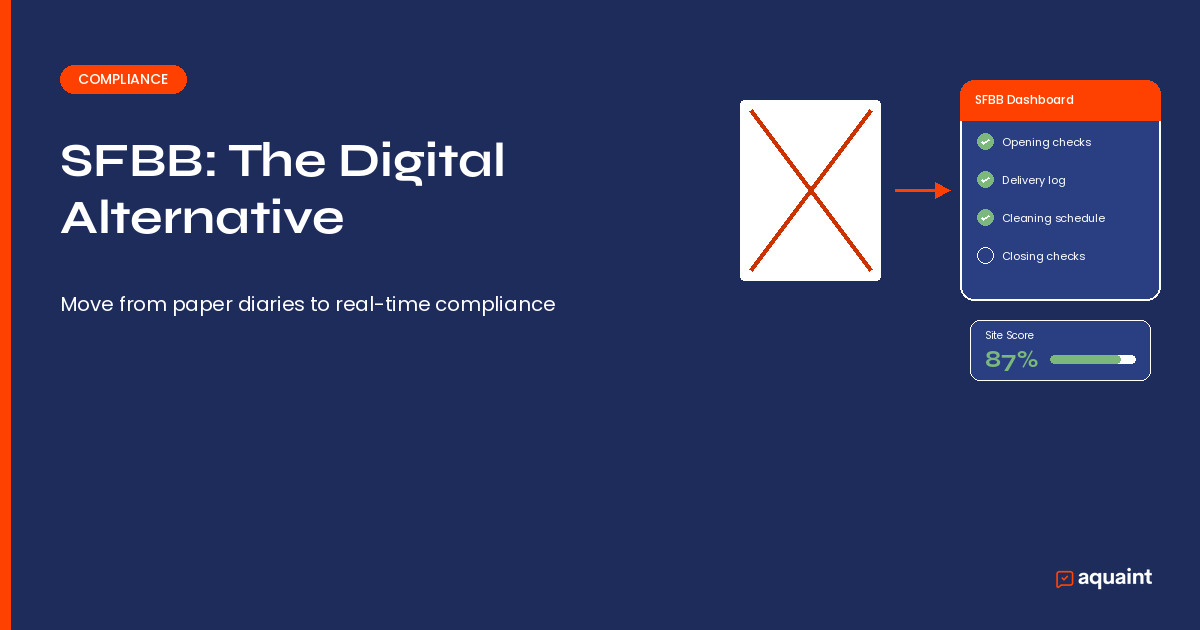
SFBB: The Digital Alternative
Last updated: May 2026
Safer Food Better Business has been the backbone of food safety management for small UK food businesses since the Food Standards Agency (FSA) introduced it in 2005. Twenty-one years later, hundreds of thousands of venues still rely on it.
But here is the question nobody seems to ask: is a paper-based system designed two decades ago still the best way to manage food safety in 2026?
If you are using SFBB right now, or thinking about starting, this guide explains what it is, where it falls short, and why digital alternatives give you better compliance with less effort.

What Is SFBB?
Safer Food Better Business is a free food safety management system provided by the FSA. It was designed to help small food businesses comply with food hygiene regulations without needing to build a HACCP plan from scratch.
The system comes as a printed pack (or downloadable PDF) organised into sections:
- Safe methods - covering cross-contamination, cleaning, chilling, and cooking
- Opening and closing checks - daily procedures for starting and finishing service
- Diary pages - for recording daily checks, temperatures, and any issues
- Review pages - for periodic reviews of your food safety practices
Each section explains what to do and why, in straightforward language. Staff fill in the diary pages to record that procedures have been followed.
There are different versions for different business types. Restaurants and takeaways use the standard pack. Childminders, care homes, and retailers have tailored versions.
Who Needs SFBB?
Any food business needs a food safety management system based on HACCP principles. For large operations, that usually means a bespoke HACCP plan. For smaller businesses, cafes, takeaways, pubs, small restaurants, the FSA recommends SFBB as an accessible alternative.
EHOs expect to see either a proper HACCP-based system or SFBB (or equivalent) in place. If you have nothing, you will score poorly on the confidence in management category during your food hygiene inspection.
SFBB is not a legal requirement in itself. The legal requirement is to have a documented food safety management system. SFBB is one way to meet that requirement. But it is not the only way, and for a growing number of venues, it is not the best way.
The Limitations of Paper SFBB
SFBB was a good idea when it launched. It gave small businesses a structured, free way to manage food safety. But paper-based systems have inherent problems that no amount of good intentions can fix.
Records go missing
Paper in a kitchen is a disaster waiting to happen. Diary pages get splashed, stained, torn out, or thrown away during a clean. The pack gets buried under menus and supplier invoices. When an EHO asks to see your SFBB records, rummaging through a soggy folder does not inspire confidence.
Completion is impossible to verify
Did someone fill in the diary at the time the check was done? Or did they complete a week's worth of entries on Monday morning? With paper, there is no way to tell. There are no timestamps, no location data, and no verification that the person recording the information was even on site.
It does not adapt to your business
SFBB is generic by design. It has to work for a fish and chip shop, a fine dining restaurant, and a sandwich van. That means it does not reflect your specific menu, your layout, your equipment, or your risk profile. EHOs increasingly expect food safety systems that are tailored to the individual operation, not one-size-fits-all packs.
Multi-site management is a headache
If you run more than one location, each site needs its own SFBB pack. There is no way to see an overview of compliance across your estate. You cannot compare performance between sites, identify patterns, or spot a location that is falling behind without physically visiting it.
It only covers food safety
SFBB handles food hygiene procedures and temperature records. That is it. It does not cover allergen management, incident logging, health and safety documentation, team communications, maintenance requests, or any of the other compliance areas a hospitality business needs to manage. So you end up with SFBB for food safety, a separate folder for allergens, another system for health and safety, WhatsApp for team comms, and email for maintenance. That fragmentation creates gaps.
No reminders or prompts
Paper does not chase you. If someone forgets to do the opening checks, the paper does not send a notification. If temperatures have not been recorded by noon, nobody gets an alert. Compliance depends entirely on human memory and discipline, which are unreliable in a busy hospitality environment.
Why Digital Compliance Is Better
A digital food safety management system addresses every limitation of paper SFBB while adding capabilities that paper cannot match.
Everything is timestamped
When a team member completes a temperature check digitally, the system records who did it, when they did it, and from which device. No more backdated diary entries. No more "I think that was filled in last Tuesday." Every record is verified and tamper-resistant.
Records cannot get lost
Digital records are stored in the cloud. They do not get splashed by the dishwasher, buried under paperwork, or accidentally thrown in the recycling. They are accessible from any device, at any time, from any location. When an EHO asks to see six months of temperature records, you can pull them up in seconds.
Built-in reminders keep compliance on track
Digital systems can prompt your team when checks are due. If the morning temperature round has not been completed by 10am, the responsible person gets a notification. If a fridge temperature is logged outside the safe range, the system can flag it immediately and prompt a corrective action. This is the difference between reactive and proactive compliance.
Tailored to your operation
Unlike a generic paper pack, a digital system can be configured for your specific menu, your layout, your equipment, and your processes. The checklists your team completes reflect what your venue needs, not what a generic template assumes.
Multi-site visibility
For operators with more than one location, digital compliance provides a single view across all sites. You can see which locations completed their checks, which ones have outstanding issues, and where scores are trending downward, all without leaving your desk.
How Aquaint Replaces and Extends SFBB
Aquaint is not a digital version of SFBB. It is a complete replacement that covers everything SFBB does and far more besides.
Here is what you get:
- Digital checklists - Opening checks, closing checks, cleaning schedules, and temperature rounds. All customisable to your operation. All timestamped and tied to the team member who completed them.
- Temperature monitoring - Log fridge and freezer temps, hot holding temps, probe readings, and delivery temperatures. Out-of-range readings trigger immediate flags.
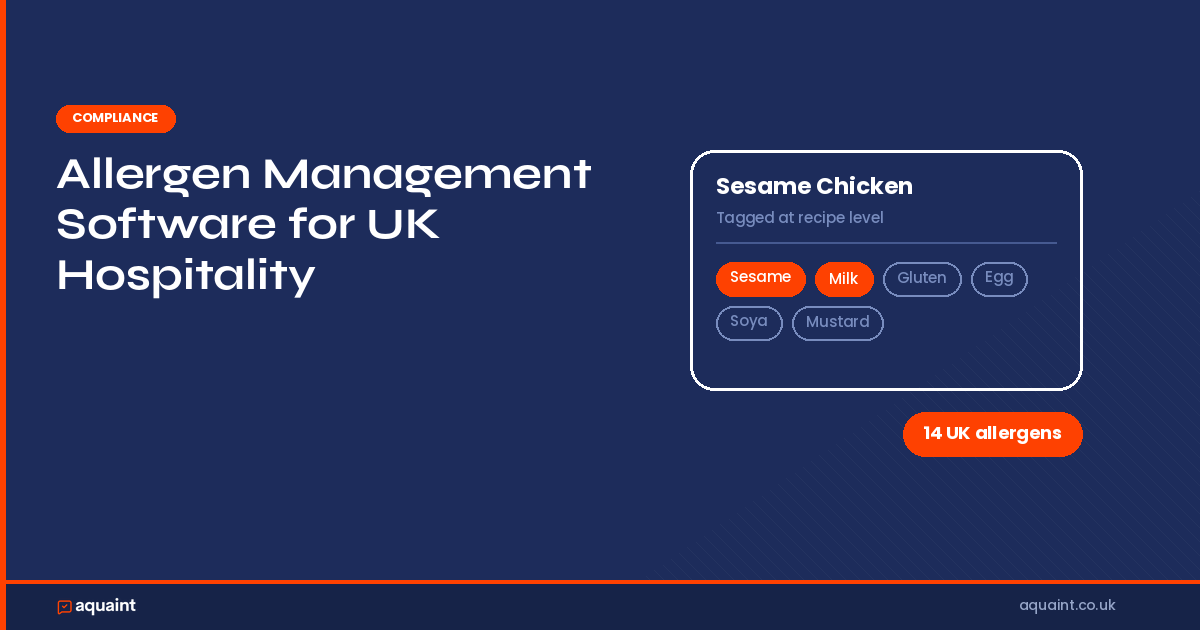
- Allergen management - Enter your menu items with full allergen tagging. Update once and the information is current across every site. No more outdated paper matrices. Read our full guide on the 14 UK allergens.
- Document management - Store your HACCP plan, safety data sheets, training certificates, supplier specs, and any other compliance documents in one place. Accessible from any device.
- Incident and refusal logging - Record incidents, accidents, refusals, and near-misses digitally. If you need to make a RIDDOR report, the information is already captured.
- Team communications - Replace WhatsApp and text messages with a GDPR-compliant communication tool built for hospitality. Push updates, share information, and track acknowledgments.
- Maintenance ticketing - Report equipment issues, track repairs, and keep a record of maintenance activity. No more scribbled notes that get lost.
- Site scoring - See how each location is performing across all compliance areas. Identify trends, compare sites, and focus attention where it is needed.
- Audit-ready reports - Generate compliance reports that show your complete food safety management history. When an EHO visits, you can demonstrate everything from a single app.
The difference between SFBB and a platform like Aquaint is the difference between a checklist and a system. SFBB tells you what to do. Aquaint helps you do it, proves you did it, and connects it to every other compliance requirement your venue faces.
Making the Switch from Paper
If you are currently using SFBB and thinking about going digital, the transition is simpler than you might expect.
You do not need to throw away your SFBB pack on day one. Many venues run both systems in parallel for a week or two while their team gets comfortable with the digital version. The paper pack served its purpose. The goal now is to move to something that serves your business better.
The biggest change is cultural, not technical. Your team is used to scribbling on a sheet of paper. Now they are completing checks on a phone or tablet. Most people adapt within a few days. The ones who resist usually come around when they realise the digital system is faster, not slower, than paper.
For a deeper comparison of the two approaches, read our guide on paper versus digital compliance.
What About Cost?
SFBB is free. That is its biggest selling point. And for a single-site cafe with a tiny margin, free matters.
But free is not the same as cheap. Consider the hidden costs of paper compliance: the time spent filling in forms, the time spent filing and retrieving records, the cost of reprinting packs, the risk of a lower EHO score (and the lost revenue that can bring), the management time spent chasing compliance across sites.
For venues saving 5 to 10 hours per site per week on compliance admin, as many Aquaint customers report, the return on investment is clear. That is time your team can spend on service, training, or preparation instead of paperwork.
The question is not whether you can afford to go digital. It is whether you can afford not to.
Frequently Asked Questions
Will an EHO accept a digital system instead of SFBB?
Yes. EHOs require you to have a documented food safety management system based on HACCP principles. SFBB is one option, but it is not the only accepted format. A digital system that covers the same areas, with proper records and audit trails, meets the legal requirement. Many EHOs prefer digital systems because the records are more reliable and easier to review during an inspection.
Is SFBB a legal requirement?
No. SFBB itself is not a legal requirement. The legal requirement under EU-retained food hygiene regulations is to have a food safety management system based on HACCP principles. SFBB is a free tool the FSA provides to help small businesses meet that requirement. You can use any system that achieves the same outcome, whether that is SFBB, a bespoke HACCP plan, or a digital compliance platform.
Can I use Aquaint if I already have an SFBB pack?
Absolutely. Many of our customers started with SFBB before switching to Aquaint. You do not need to complete any additional setup beyond configuring the app for your venue. Your existing SFBB records can be kept for reference, and your new digital records pick up from day one. There is no gap in compliance coverage during the transition.
Does Aquaint cover everything in the SFBB pack?
Aquaint covers all the food safety areas included in SFBB: cross-contamination, cleaning, chilling, cooking, opening and closing checks, and daily diary records. It also extends well beyond SFBB to include allergen management, document storage, incident logging, team communications, maintenance ticketing, and multi-site reporting. It is a complete compliance platform, not a digital photocopy of a paper pack.
What happens to my compliance records if I cancel Aquaint?
Your data belongs to you. If you ever decide to leave, you can export your records. We do not hold your compliance history hostage. That said, with zero customer churn since launch, it is not a situation we have had to deal with yet.




Let's get aquainted - sign up to our newsletter
Join our newsletter to stay up to date on features and releases.